Chiburi
In many iai Ryu, chiburi is a fundamental and integral part of the kata. Chiburi (usually written 血 振 in Japanese) literally means “shaking off the blood”, and the image it is meant to convey is that of a movement that shakes the blood of a defeated enemy from the blade before it is returned to the scabbard.
Perhaps mainly because of the prevalence of the Muso Shinden-ryu and Muso Jikiden Eishin-ryu schools, some people believe that chiburi is a universal aspect of iai. In many Ryu, however, it is not practised, and there is an opinion — which has become more widespread recently also thanks to the sharing of knowledge on the internet — that “shaking” blood off in this way is in fact impossible.
If this is true, then what is chiburi for? Is it useless? Why do some Ryu practise it? Was a special movement really needed to remove blood from a blade?
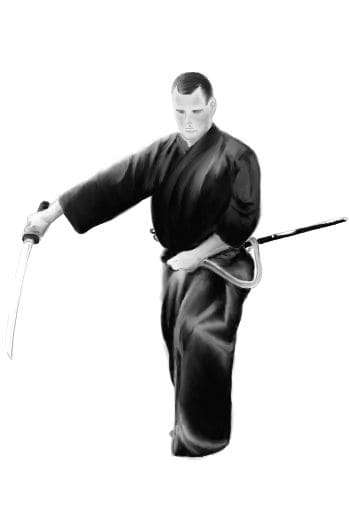
Chiburi is a modern reading of a word that appears in the densho of Eishin-ryu as 血 振 or 血; the original pronunciation was most probably chiburui, which is the reading found when looking the word up in a Japanese dictionary, for example the Kojien.
In the book Koryu Iai no Hondo, an Eishin-ryu teacher, Morita Tadahiko, is quoted as saying that the correct term is chiburui, and that chiburi is in fact an incorrect reading (the word chiburi that appears in the dictionary actually refers to a method of preparing fish).
Iwata Sensei (Muso Jikiden Eishin-ryu) also observes that both Oe Masamichi and his teacher, Mori Shigeki, referred to the movement as chiburui. For the purposes of this short article, however, the term chiburi will be used, since it is the one most people know and, for better or worse, it has now entered common usage in most iai circles.
Unluckier beginners who start studying iai may perhaps be taught that the purpose of the chiburi movement is to remove blood from the sword after the cut; in many books on iai as well, chiburi is described as necessary for this purpose.
The iai schools Muso Jikiden Eishin Ryu and Muso Shinden Ryu also contain a further form called chinugui (cleaning the blood from the blade with a cloth, or with paper or the fingers) in a limited number of techniques in the first level of teaching, Omori (Shoden/Seiza no bu).
In Muso Jikiden Eishin Ryu this is technically performed by placing one hand inside the hakama, using it to clean the blade. In practice, however, even when this form is performed the blade is not actually wiped on the hakama, since the oil used on swords would stain the clothing. Although more people have recently realised that the idea of chiburi is not truly a practical method for removing blood from the blade, it has nevertheless been explained by teachers in Japan in this way for a long time.
Kono Hyakuren, 20th Soke of Muso Jikiden Eishin Ryu, wrote in his book Iaido Shintei:
“Chiburui: this takes the form of shaking the blood from the sword and making it fall to the ground. However, in my experience, when one cuts with a sword, very little blood actually remains attached to the blade. Nevertheless, placing emphasis on zanshin and spirit through the form of chiburui makes it a useful tool for development.”
Kono Sensei was not the only one to understand chiburi primarily as a method for developing zanshin; Nakayama Hakudo wrote:
“In batto, chiburi is always performed in every kata before the sword is returned to the scabbard. This movement cannot completely clean the blood from the blade, but it should be thought of as a purifying action. The interval between chiburi and noto is a very important phase in battojutsu, since it is a manifestation of zanshin within the kata.”
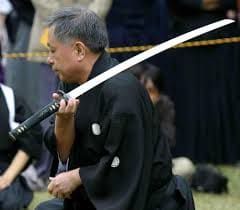
Obviously, every iai school has a different method and form for performing this action.
Some characteristic methods are, for example:
In Kanshin Ryu, a piece of paper kept inside the kimono (kaishi, 懐 紙) is used to clean the blade.
In (Shindo) Munen Ryu, the sword is pointed downward so that the blood drips from the tip; the sword is then brought in an arc along the left side of the body, allowing the blood to run off the blade.
In Hazama Ryu, the sword is rested on the left shoulder and the blood is wiped on the shoulder itself.
In Fuchishin Ryu, the sword is “pinched” between thumb and index finger, which are then slid from the base of the blade to the tip to clean off the blood.
In Hayashizaki Hon Ryu, the sword is held in the right hand and is first brought with a small movement to the left, then with a broad movement to the right before being returned to the scabbard.
Other schools, such as Omori Ryu, Kikusui Ryu, Jigen Ryu, Ryushin Shouchi Ryu, Kaishi Ryu, Tamiya Ryu, Shingan Ryu, Tetchu Ryu, Hasegawa Ryu, and others, perform chiburi in still different ways (Tatsumi Ryu, for example, does not perform chiburi but instead brings the sword into chudan, thereby expressing zanshin before performing noto); and there are also some schools that do not perform chiburi at all.
In some schools, in fact, the saya is thrown behind oneself after the sword has been drawn. Throwing the saya traditionally expresses the swordsman’s determination to die in combat (sutemi, 捨身), so once the sword has been drawn it will no longer be returned to the scabbard (…personally, it does not seem particularly shrewd to begin with the preconceived idea of wanting to die in combat… fortunately I am not Japanese).
Nakayama Sensei states that although not all schools practise what today we would call chiburi, all of them nevertheless seem to emphasise zanshin before resheathing; and in many schools this zanshin is manifested in the cleaning, whether simulated or actual, of the blade.
The iai schools that perform chiburi would seem largely to belong to the Hayashizaki family of Ryuha, Mugai Ryu, Suio Ryu, and Shinmuso Hayashizaki Ryu; while in schools that do not descend from Hayashizaki, other forms of blade-cleaning can often be found.
One form that, for example, does not seem to appear in the schools derived from Hayashizaki is kaiten chiburi, in which the sword is “spun” in one hand and the other hand is then struck against the tsuka. This form can instead be found in old and well-known Ryuha such as Tenshin Shoden Katori Shinto Ryu, Kashima Shinto Ryu, Jigen Ryu, and in some branches of Takenouchi Ryu.
Other non-Hayashizaki schools, such as Seigo Ryu, Shinkage Ryu, Hoki Ryu, Sosuishi Ryu, Tatsumi Ryu, and others, may omit chiburi completely, opting instead for chinugui or even, to the eye of an external observer, apparently for nothing at all.
Despite the many differences among the various Ryuha, however, one has yet to encounter a school that does not emphasise and express a clear zanshin during the act of cleaning the sword, or in any case before returning the weapon to the scabbard.
In the previous quotation, one may notice how Nakayama Hakudo uses the word chiburi to refer to cleaning methods that technically fall under chinugui. This suggests that perhaps, in the past, chiburi may have been used as a generic term encompassing the various forms of sword-cleaning, ritual purification, and other manifestations expressing the concept
of zanshin before resheathing. If so, this may perhaps have contributed to the myth of the omnipresence of chiburi.
Looking broadly at the chiburi of Muso Jikiden Eishin Ryu and Muso Shinden Ryu, one sees that, despite some variations, it takes two fundamental forms:
-
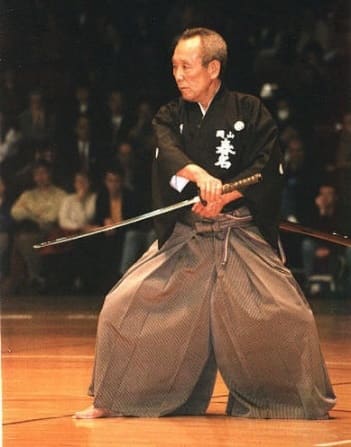
the first type students encounter is the chiburi characteristic of Omori-ryu; this is commonly referred to as o-chiburi (大 血 振), meaning “large chiburi”, and is performed by bringing the sword’s tsuka to the right temple while rotating the tip in an arc, as if cutting along the line of a migi kesa;
-
the other form of chiburi is commonly called yoko-chiburi (横 血 振) or kochiburi (小 血 振), and is performed by moving the sword to the right with the blade parallel to the floor.
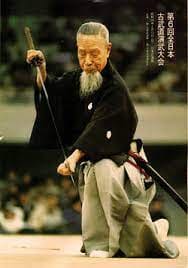
Despite the sharpness of the movement, however, it should be clear that neither yoko-chiburi nor o-chiburi is in any way practical or efficient for removing blood from a blade. So why is this movement called chiburi? The truth is that this large movement performed in Omori-ryu has been called by that name for a considerable period of time, as can be shown by consulting the Omori-ryu sections of the Edo-period densho from Shimomura-ha and Tanimura-ha Eishin Ryu.
However, when we move to the same movement in Hasegawa Eishin Ryu (Chuden and Okuiai), the word suddenly disappears from the densho. In the descriptions of both Omori Ryu and Hasegawa Eishin Ryu, what is commonly called today yoko-chiburi is called “opening” (開 き) or “opening to the right” (右 に 開 き); not once is it mentioned as chiburi. The idea of this movement as “shaking blood from the blade” may therefore have originated later.
Masaoka Katsutane, holder of the Muso Jikiden Eishin Ryu Kongen no Maki (Menkyo Kaiden) of the eighteenth generation, wrote on the matter in his book Muso Jikiden Eishin Ryu Iaiheiho Chi no Maki:
“In Omori Ryu, before noto, chiburi is performed in the form of a broad sword stroke from above the head. This ‘opening’ is today called ‘small chiburi’. One day after the war I was teaching iai to children in Kochi when a child asked me, with the directness typical of children: Sensei, what really shakes the blood from the blade? I thought about it for a long time and reread all the densho in my possession, and I found that in no densho is this movement indicated as chiburi. Instead, it is called ‘opening to the right’. I therefore came to the conclusion that Omori Ryu’s chiburi is a combination intended to express zanshin and prepare for noto; and from Eishin Ryu onward, the movement is for performing zanshin, and not merely preparation for noto.”
A further examination of the surviving pre-modern densho of Tosa Eishin Ryu reveals that, while there is a clear lack of references to chiburi, there are some passages in high-level documents that describe special methods for quickly cleaning a sword when it must be returned to the scabbard. Significantly, these methods are all variants of chinugui, which, as already mentioned, is seen as a practical way — probably the only one — of cleaning the sword (and it seems that Eishin Ryu practitioners in the Edo period had no other illusions). It is quite plausible that in Eishin Ryu chinugui was used for cleaning the blade in real situations, but was simply omitted from most kata.
The cultural shift that occurred when swords could no longer be worn in everyday life in Japan, and the subsequent change to the modern structure and teaching approaches of Muso Jikiden Eishin Ryu and Muso Shinden Ryu, would moreover easily have led to the loss of this knowledge among most practitioners. Looking at all these clues, we can therefore conclude that what we today call chiburi was probably not originally intended as a practical cleaning method. It is much more likely that the form of chiburi appearing in most iai waza was developed to cultivate zanshin; in some cases, chiburi was perhaps even approached as a kind of ceremonial purification.
Obviously this is not a surprising conclusion: most people already sense it on their own. However, by providing a historical context, we can come a little closer to understanding the true purpose behind the actions we are learning to perfect.