Conditions and Elements Governing the Practice and Study of a Kata/Technique
KATA – meaning and components
In almost all Eastern disciplines drawn from the warrior experience of past centuries, there are formal exercises – called Kata – that serve many functions. A Kata is normally understood as a reference model that remains as immutable as possible over time, or that may be modified only by great experts in the discipline, and only for carefully considered and well-justified reasons. Kata have always been conceived with the purpose of:
-
transmitting the principle of an action, or of several actions linked together, in terms of biomechanics, mechanics, physics, strategy, tactics, and their actual execution;
-
allowing the analysis of mental states during the various phases of action, with reference both to breathing and to the management and use of Ki;
-
preserving the origin of actions that were later transformed by the needs of practice;
-
transmitting the hidden aspects of the Discipline, which go beyond mere technical execution and draw on the primary philosophical roots underlying the physical Discipline.
In the formal execution of a Kata, the study of what it contains will allow the practitioner to extract its principles and explore them more deeply, reproducing them through essential movements. The aspects understood from a merely technical point of view will therefore not be the most important; rather, what matters is their expression as a principle – the Kata thus become, in our hands, a [matrix]{.underline}. This would remove any doubt about which outward gesture is most correct in any technique of any Kata: the most correct gesture will always be the one that refers back to the principles that a given Form is intended to express… provided that it is correct, coherent, and consistent with those principles.
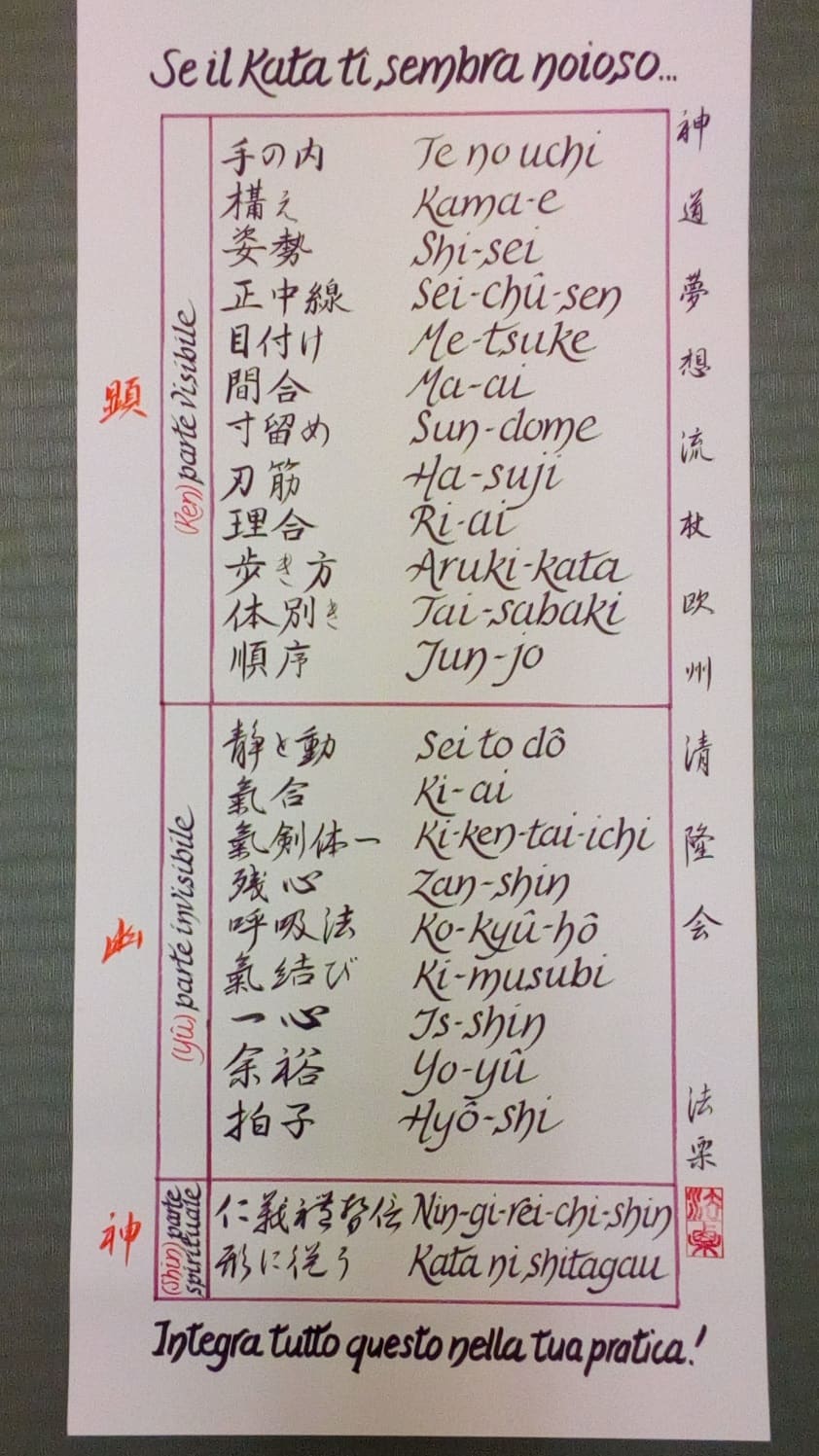
…and should someone, at a certain point in their experience, come to think that Kata have become, all things considered, fairly simple, boring, and repetitive, here is a list of all the elements that must constitute them.
KEN the visible part
Te no Uchi the grip (of a weapon or of an opponent) TE: hand NO: genitive, possessive pronoun UCHI: inside, inner
Kamae combative posture (KAMA: construction E: end, conclusion, term in Hiragana)
Shi Sei posture (SHI: form, appearance, aspect, bearing SEI: energy, power, influence, authority)
Sei Chu Sen the central line, verticality
Me Tsuke the gaze (ME: eye TSUKE: to glue, to apply)
Ma Ai distance (MA: time, space AI: principle)
Sun Dome control (SUN: 3.03 cm DOME: to stop)
Ha Suji the correct path / quality of the angle of a weapon’s trajectory (HA: cutting edge of a blade)
Ri Ai logic and harmony (RI: reason, logic AI: unity, harmony)
Aruki Kata way of moving/walking (it could also be translated as Ashi Sabaki – movement of the feet)
Tai Sabaki body movements (TAI: body SABAKI: movement)
Jun Jo order, progression (JUN: order, system, obedience JO: beginning, order)
YU the invisible part
Sei To Do action/non-action, stillness and movement (SEI: calm, serenity TO: and DO: action, movement)
Ki Ai the unification of energy (KI: energy AI: harmony, unity)
Ki Ken Tai coordination (KI: energy, spirit KEN: sword but by extension any external object, TAI: the body)
Zanshin awareness of spirit (ZAN: to remain, to continue, continuation SHIN: mind, heart, spirit)
Ko Kyu Ho the correct method for using breathing
Ki Musubi knotting/binding of energy – when Nage envelops and establishes the bond with the energy of Uke (KI: energy MUSUBI: to knot/bind)
IsShin with the whole heart (ICHI: one SHIN: heart)
Yo Yu margin (YO: rest, remainder, surplus YU: abundant, rich, fertile)
Hyo Shi rhythm
Shin the spiritual part
Go Jo the five virtues (GO: five JO: condition, morality, virtue)
GO-JO appears in many certificates of classical traditional martial schools; it is a set of Confucian principles that encourage the recipient of the certificate, or the human being in general, to be worthy of that name.
-
Nin or Jin means Benevolence, or human warmth.
-
Gi is Justice.
-
Rei is Etiquette, Courtesy.
-
Chi is Knowledge.
-
Shin is Faith, Belief, Worthy Conduct.
It takes a great deal of time to understand both their order and their qualities.
In time one understands that Nin was not placed at the head of the list by chance. The following four virtues have a “double edge”; only Benevolence can give them their true meaning.
Justice can become the blind execution of inhuman laws; Courtesy can become obsequious self-interest; Knowledge can be directed toward inventing instruments of mass destruction; total Faith and Belief can inspire atrocities committed in their name.
Katana ni Shitagau do not change the Kata, but study what is inside the form
TE – NO – UCHI: THE GRIP (of a weapon or of an opponent)
TE: hand
NO: genitive, possessive pronoun
UCHI: inside, inner
A beginner is generally not very sensitive to the concept of Te-No-Uchi; only after many years will they realize how extremely important it is in making all things fall into their proper place. The hands are links between us and external bodies (a weapon, an opponent, an object), and the angles formed between our arms and the object being grasped must be very precise in order for energy to be transmitted correctly.
To obtain the correct feeling and maximum effectiveness, it is interesting to observe that the life line of our hands is very close to the line of extension that our arms must follow when we hold a weapon or grasp an opponent. It is only after many years of practice that the objects we grasp become one with the body, just as our own hands are fully part of it.
When we grasp something, and not only when applying a technique, the feeling should be compared to the following image: grasp as though you had to hold a small bird in your hand – if you squeeze it too hard, it will die; if you hold it too loosely, the bird will fly away.
KAMA – E: THE COMBATIVE POSTURE
KAMA: construction
E: end, conclusion, term (in Hiragana)
Nowadays, when two Japanese people meet, exchanging business cards is one of their priorities. In the time of the Bushi, Kamae was a way of presenting oneself to one’s opponent; the combative posture was usually accompanied by a declamation of titles and deeds of glory, as well as various invectives directed at the opponent. In present-day Budo, assuming a correct Kamae is an essential element of skill.
Concretely, it is the construction of a bodily attitude that not only tends to “impress” the opponent through impeccable Shisei, but at the same time allows a technique to be applied promptly and instantly. Even if outwardly one appears to be in a state of immobility, Kamae is an inner dynamic movement.
In the Dojo, as elsewhere, Kamae reflects our state of mental attitude and our competence.
SHI – SEI: POSTURE
SHI: form, appearance, aspect, bearing
SEI: energy, power, influence, authority
Shisei does not mean only having good posture; it also includes the idea that one must be able to do what one has to do in the best and most optimal way. More generally this means that the back should be straight, the shoulders relaxed, and the gaze directed straight ahead. For all these reasons Shisei represents an image of power, as literally described by the ideograms that identify it.
There are several sub-components of Shisei: the gaze (Me-Tsuke), the vertical axis of gravity (Sei-Chu-Sen), breathing (Ko-Kyu-Ho), and the mental state of non-attachment (Mu-Ga-Mu-Shin).
Only when all these elements are present does Shisei begin to become convincing.
EN – ZAN – NO – ME – TSUKE: THE GAZE (LOOKING AS ONE LOOKS AT A DISTANT MOUNTAIN)
EN: distant
ZAN (or SAN): mountain
NO: possessive (Hiragana)
ME: eye
TSUKE: to glue, to apply
The practitioner’s line of sight, or gaze, should be the same as the one we use when admiring a distant mountain. This type of vision allows us to perceive everything around us; a much less romantic image, drawn from present-day experience, is the gaze one should maintain when driving a car.
En-Zan-Me-Tsuke is very close to the idea of Kan-Ken (intuition/perception and gaze).
What we want to achieve is mainly to use our intuition in order to “sense” any danger that the eye has not yet identified. This way of looking should not be distracted by blinking, and should be directed straight ahead, toward the opponent’s face or the base of the neck, so that every movement of the shoulders becomes immediately perceptible.
A global vision is preferable to concentrating on a single point, or on a detail.
MA – AI: DISTANCE
MA: the base, foundations
AI: principle
In Japanese the character MA is used for both “time” and “space”.
Distance is an abstract concept unless it is related to the concept of time. It is the time required by an opponent to cover the distance separating them from us that gives meaning to the situation, and vice versa.
The character MA symbolizes a gate (the two parts on the left and right), an element of proximity through which one can see the sun (the central part of the ideogram), the most distant element visible to human beings in the classical period. In Budo this is a very important concept, often greatly underestimated by practitioners because they have not yet been exposed to a real combat situation and have therefore never fallen victim to an erroneous judgment of their Ma-Ai.
Give the events of daily life the importance they deserve; respect the individual sphere, the vital space, of every human being around us.
SUN – DOME: CONTROL
SUN: 3.03 cm
DOME: to stop
In every movement there must be an element of control, otherwise it is merely gesticulation. In Budo, all the more so, Sun-Dome (or Kime) is not only a guarantee of safety, but also corresponds to a new Kamae through perfect control of the final phase of the movement. In order to create perfect Sun-Dome, we need to incorporate, among other things, the concepts of Te-No-Uchi, Ki-Ken-Tai, Shi-Sei and Ki-Ai.
When these elements are correctly and harmoniously assembled together, control can be achieved with the precision of 1 Sun (1 Sun = 3.03 cm).
Going beyond the limits of one’s target is often worse than not reaching it at all.
RI – AI: LOGIC AND HARMONY
RI: reason, logic
AI: unity, harmony
One could say that Ri–Ai is the backbone of a traditional martial school. It is the thread that we discover within our techniques and that gives the measure of our degree of learning. We have Ri–Ai when all the techniques of a School form a coherent whole, which has allowed them to survive through the centuries. Ri–Ai can be seen in several ways:
the first degree of Ri-Ai is represented by the concrete logic of a technique; this means that, in order to reach one’s objective effectively, one must adjust one’s distance with absolute precision, since any negligence in the correct evaluation of this factor will have negative consequences for the entire development of the technique;
the next degree concerns the logic behind the application of different techniques, all belonging to the tradition of a school;
the third degree of interpretation of Ri–Ai can be defined as a global logic visible within all the disciplines of Japanese Budo: it may be the biomechanical principle by which one takes hold of a Judogi, or grips a sword, or the wrist of one’s opponent; it may be a question of mental or moral principle (the etiquette observed inside the Dojo, the bow), or again, more globally, a philosophical concept (victory over oneself, suppression of the ego).
“Everything is one!” is a statement that reflects the universal idea of Ri–Ai.
JUN – JO: ORDER, PROGRESSION
JUN: order, system, obedience
JO: beginning, order
There is an order to all things. Sometimes this order is arbitrary, sometimes numerical, genealogical, or hierarchical; it is often disliked, yet it may conceal lost, esoteric knowledge, or sometimes simply common sense. In the same way that we must be able to master harmony before we can break it, it is important to know the order of things before we can – if necessary or if we wish – free ourselves from them.
In many traditional schools the order of techniques is not arbitrary; one technique provides the elements needed for a better understanding of the next, and so on. In this case, mixing the order will only create tangled confusion. Claiming to teach when one does not have sufficient knowledge, engaging in combat when body and mind are not prepared, claiming to know others when one does not even know oneself – all these are errors of Jun-Jo.
We probably cannot say with certainty which came first, the egg or the chicken, but we should nevertheless leave things in their proper order when such an order exists and is known to us.
SEI – TO – DO: ACTION NON-ACTION (STILLNESS AND MOVEMENT)
SEI: calm, serenity
TO: and
DO: action, movement
Far from considering these two concepts separately, on the same plane, they merge together. There is always action within non-action, and non-action continues to influence action.
From a practical point of view, respecting this principle should suppress and suffocate every preparatory movement, such as setting up an attack, readjusting the feet in order to consolidate the stance, hesitation in movement, tension in the face and body, or uncontrolled breathing.
The ability to use the principle of Sei–To–Do correctly serves to achieve perfect mastery of elements such as Shisei (correct posture), Sei–Chu–Sen (verticality of one’s center of gravity), Kokyu (correct breathing), and, in particular, great inner freedom. Sei–To–Do also describes the rhythm of a technique, in which attacking movements are marked by lightning-like sobriety and the other elements are governed by great serenity.
Spontaneity exists when action arises from non-action, free from warning signals.
KI – AI: UNIFIED ENERGY
KI: energy
AI: harmony, unity
In our overly crowded society, we teach children not to shout or cry so as not to disturb our neighbors. In Budo, we often observe that beginners have serious difficulty letting out their first Ki-Ai. For the study of Budo, we must be able to execute a Ki-Ai, since it is essential for allowing the circulation of energy and for aiding control and precision (Sun-Dome); putting “the heart in the belly” can also seriously disorient an unprepared opponent.
At first, Ki-Ai is only a shout from the throat; after some years of practice the sound begins to descend toward the abdominal level (Seika-Tanden – the center of energy located behind and below the navel), and it will be this energy that makes the vocal cords vibrate as it flows outward. Much later, Ki-Ai can become silent without losing any of its power.
Rediscover our first cry at the moment of birth.
KI – KEN – TAI: COORDINATION
KI: energy, spirit
KEN: sword (but by extension any external object)
TAI: the body
It is the harmonious coordination of three elements, without which no movement is truly applicable. Often, among the principles of Budo, the most difficult and most important aspect to master is Ki. A child learns to coordinate their own body before attempting to master an external element (a toy, a pen, …); only afterward do they confront the problem of how much energy to measure out and apply in order to use the object correctly.
Ki-Ken-Tai is the harmonious coordination of these three elements, without which no action would be truly effective.
Ki-Ken-Tai is directly related to other principles: Shi-Sei (posture), Te-No-Uchi (grip), Sei-Chu-Sen (vertical axis of gravity), Ko-Kyu-Ho (correct breathing), Sei-To-Do (harmony of rhythm), and so on.
ZAN – SHIN: THE AWARE SPIRIT – AWARENESS OF SPIRIT
ZAN: to remain, to continue, continuation
SHIN: mind, heart, spirit
Zanshin literally means: “to leave the spirit” (kokoro no wokosu). This term is often translated in a limited and reductive way simply as “vigilance”, but the idea of Zanshin goes beyond that. The state of awareness represented by good Zanshin after an action is almost tangible and truly leaves something indefinable, felt by both opponents.
One could say that Zanshin is a retrospective and motionless contemplation of the action just performed; more generally, and without taking into account the literal meaning of Zanshin, this concept can be defined as the state of awareness, of vigilance, with which all combative techniques must be carried out.
Zanshin must be maintained fully throughout the techniques and engagements, without weakening or diminishing, until the final bow. In the case of a series of Kata, it must be continuously present throughout the entire sequence of movements.
One may even go so far as to say that correctly mastered Zanshin begins when one enters the Dojo and must not be interrupted before leaving it.
Remaining permanently aware of everything around us, at every instant, is to live with greater intensity!
ISSHIN: WITH THE WHOLE HEART
ICHI: one
SHIN: heart
Once one masters the technique (will that ever really happen?), there is only one way to apply it – with the whole heart! Without, however, losing all the elements of control, precision, distance, and balance. At first glance, these elements seem totally at odds with the concept of Isshin. This concept concerns the movement itself, while all elements external to it must remain well controlled and impeccable within the structure. Resolving this paradox is the work of many years…
A good example of Isshin can be seen in a Judo throw, where Tori (the one who throws) carries out the technique with the totality of their body, falling together with Uke (the one who is thrown). During the movement, when the two bodies are in a state of “weightlessness”, the idea of control remains absolutely fundamental: Tori performs the movement with the aim of making Uke fall to the ground first, and without danger to Uke, while at the same time landing in a position that allows Tori to apply an immediate immobilization.
With the whole heart, certainly, but not in just any manner…
YO – YU: MARGIN
YO: rest, remainder, surplus
YU: abundant, rich, fertile
Margin means that, through a sober and efficient execution, one gains a certain space/time margin within a given technique. It is a remarkable moment when you have time at your disposal while standing inside the eye of a cyclone. Mastery, in all things, is the ability to take your time and still remain perfectly efficient.
GO-JO: THE FIVE VIRTUES
GO: five
JO: condition, morality, virtue
Go-Jo appears in many certificates of classical traditional martial schools. It is a set of Confucian principles that encourage the recipient of the certificate, or the human being in general, to be worthy of that name.
-
Nin or Jin means Benevolence, or human warmth.
-
Gi is Justice.
-
Rei is Etiquette, Courtesy.
-
Chi is Knowledge.
-
Shin is Faith, Belief, Worthy Conduct.
It takes a great deal of time to understand both their order and their qualities.
In time one understands that Nin was not placed at the head of the list by chance. The following four virtues have a “double edge”; only Benevolence can give them their true meaning.
Justice can become the blind execution of inhuman laws; Courtesy can become obsequious self-interest; Knowledge can be directed toward inventing instruments of mass destruction; total Faith and Belief can inspire atrocities committed in their name.
If human warmth influences all our actions, we can be sure that we are on the right path.