KI KEN TAI
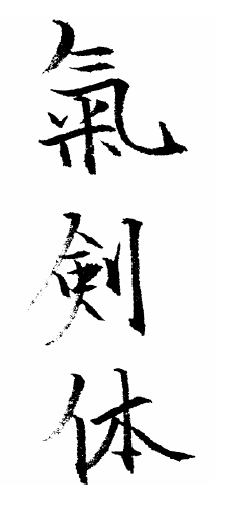
OR THE USE OF ONE’S OWN POTENTIAL AT 100%.
by Malcom Tiki Shewan
If I were asked the question – what might be the most fundamental principle that should be assimilated by a practitioner wishing to improve in Budo? I would answer without hesitation: “the concept of Ki-Ken-Tai”. Moreover, my friend Pascal Krieger and I agree in saying that approximately 90% of the corrections we can make to Budo practitioners in their practice concern elements deriving from Ki-Ken-Tai and that, once corrected, they can improve the technique by 100%.
More simply, I have translated this idea as – the Unity of Channeled Energy, Instrument, and Body.
During an external action and by means of an instrument, the human being is completely united, spiritually and physically, perfectly realizing his potential.
For Aikido, the unity of body and spirit is an absolutely indispensable element in practice, but this unity can be discovered more easily by the practitioner when he becomes aware of a third dimension: that of the instrument in his hands. Hence, I think, the importance of practicing with weapons – in this case with the Ken.
However, although the phrase Ki-Ken-Tai uses the word “Ken (sword)” to express this concept specifically, Ken can represent the idea of Instrument. And the instrument in the hands of the human being can change without altering the applicability of Ki-Ken-Tai. Thus, the artist’s “ken” will be his brush, for the musician his musical instrument, for the rider his horse, for the skier his skis, etc. In this way it is evident that this idea is not limited only to practitioners of the “Martial Arts”, but extends to all fields of human life.
The man
In the animal world, the human being is distinguished by characteristics unique to his kind.
Among them, two always come to mind which, despite their simplicity and clarity, seem to me to be of primordial importance for our expression of balance, integrated harmony, and inherent humanity:
a. Man has chosen to stand upright on his two hind limbs, stretching in this way from the earth toward the sky. This heaven-man-earth relationship is often evoked in many spiritual and/or philosophical expressions of the Eastern Budo;
b. Man uses an instrument. He is the only being in the animal world to have learned to use a more or less complex tool to carry out a more or less complicated task. This characteristic perhaps depends on the fact that, by standing upright, he has his hands free to do other things. In any case, I cannot really think that the phenomenon is so simplistic – a sort of “not knowing what else to do with his hands except tinker around ???”. No, I prefer to believe in less “accidental” origins.
KI-KEN-TAI is characteristic of Humanity and its refinement is our inheritance.
It is interesting and necessary to observe the kanji individually, but one must not forget that it is the ensemble of the three characters that expresses the idea. One cannot necessarily understand the final concept by simply defining the individual elements – they are transformed to become an idea that transcends its components.
It is a little like the relationship between three simple colors and the final shade.
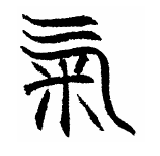
KI - The Energy of the Living Universe
In the practice of the “Martial Arts” hundreds of stories reach us about this “mysterious power” – Ki, or Ch’i according to the Chinese. One hears of masters capable, thanks to this power, of projecting opponents much stronger than themselves, or even of withstanding blows without the slightest damage. Killing a bird in full flight through a cry filled with this force, or healing someone injured or struck by a serious illness, has been the subject of a good number of anecdotes.
For the Aikido practitioner, this word is present everywhere – Aiki, Kiai, Ki-awase, Ki no Nagare, etc.
All this leaves the practitioner with an impression of vagueness rather than an exact definition, but he will nonetheless be convinced that it is something of great importance. Anyone who examines ordinary Japanese will discover an overabundance of uses:
Kimochi = good vibes
Kiryoku = vitality
Kika = vaporization
Kifu = disposition, character
Kichigai = madness
Kikan = trachea
Kiutsu = melancholy
Kishö = meteorology, climate
Kigai = courage, self-respect
In my basic dictionary there are about 175 common words that begin with the character Ki! This character can refer to banal things as well as to “sacred” and mysterious things (for example Kikon – the spirits of the dead). This does not include either the words in which the character appears as a radical at the end or in the middle, nor, again, the nuanced phrases whose meaning is determined by rational use. It is a vast term!
The classical pictographic view gives us a rich image: two linked radicals – rice and steam. Thus, a kind of plastic force, generated during the process of cooking rice, which is itself invisible except through the effects that can be observed. In a pragmatic and simple way: it is the force of life – that which makes the Universe and all things in the universe live or exist.
It is somewhat similar to our view of electricity – everyone knows it well, through what it is capable of doing, but no one knows precisely what it is. We conceive of “electrons”, we schematize their movement, but the diagrams do not explain what they are. Thus we find ourselves with a “something” that possesses a unit of “charge” and that we have created in order to make calculations.
Some have tried to explain Ki in the same terms as electricity. This brings us no closer to a concrete definition. Personal experience and lived practice will give us the best understanding.
Every human being possesses his dose of “Ki”, which, when it vanishes, makes us return to dust. The interesting thing is that there are ways to generate this potential, different methods that were discovered by men of the past.
Among all these approaches, the most fundamental consists in harmonizing Ki functionally with its envelope, that is, the body – Tai.
Man possesses this capacity and the will to accomplish it. This constitutes the beginning of the Way – Do (Michi)!
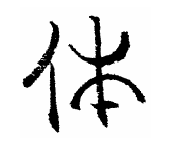
Tai - Gathered Substance
This character is very concrete and simply indicates the body of something, its material “substance”. I do not think it is necessary to elaborate further on this definition, except to say that conceptually Tai seems to occupy the opposite end of the spectrum from Ki. Above, Kiryoku indicates someone’s vitality, while Tiryoku indicates physical strength, or Tei-iku, physical education or gymnastics. Moreover, we can perceive a very strong complementarity between these ideas.
They have no meaning one without the other. What strength would the body have without its vital force? Or what meaning would “vitality” dispersed throughout the universe have without the body, its “substance/collector”?
When one is too unbalanced in relation to the other, one becomes ill, etc.
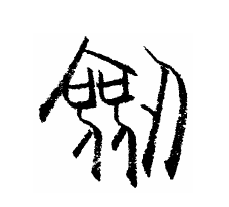
Ken- The Double Edge
The character for “sword” – Ken (also called Tsurugi) – has two radicals.
The two strokes on the right indicate the long blade of the sword, while the character on the left means “to combine”. Considering these strokes as a single whole – the symbol of the double-edged blade – we perceive something more than a simple “large knife”. The Ken is one of the three sacred treasures associated with the mythological creation of the Japanese Nation – the Ken, the Mirror, and the Jewel (Magatama). In all civilizations the sword has been conceived as a symbol of judgment and justice, even though for many years I contented myself with the image of the statue I saw in front of the courthouse. I will not reflect on it further.
Nature is a continuous dynamic process. Its unceasing movement constitutes the perfect execution of the Law of the Order of the Universe. All things, all phenomena, all beings, following this law of the universe, are at the same time the “administrators” of this order.
Green plants convert sunlight and carbon dioxide; male and female attract each other, unite, and reproduce; electricity passes from one polarity to another; the atoms of matter bind, attract, repel, and combine; magnetic forces orient themselves in different ways; the tides rise and fall under the attraction of celestial bodies; we breathe, our heart beats, etc. ad infinitum… All these things, these phenomena, these beings, by virtue of – by the will, by the authority of – through the form of their movements, constantly call upon their capacity for “judgment”. In this sense judgment can be conceived as the structure of movement. In this way Nature is justice, since the order of the Universe is always “administered” through its care (soin: care, attention, regard, charge, order; plural: attentions, cares).
This idea can be well illustrated by the Japanese word “waraku” (to understand).
The literal meaning of the term is “to be divided”. The upper radical represents “man” and the lower radical represents “the sword” (the same as the left radical of Ken), that is, “the man who cuts”; two distinct parts, separated by the act of judging; they make a whole that forms a whole, understanding (font un tout qui font un tout).
The necessary elements for the discovery of Ki-Ken-Tai
It is sometimes thought that the concept of Sei-ryoku Zen-ryo (the good use of the right force, or maximum efficiency with minimum effort) is more or less similar to the notion of Ki-Ken-Tai. In reality, it is the reverse. Ki Ken Tai allows you, as a secondary effect, to discover the best use of your forces.
That said, there are a certain number of fundamental principles that the student must put into practice in order to allow the three components of his individual being to combine perfectly and harmoniously so as to realize an action in Ki Ken Tai.
Finding one’s center of gravity
First of all, it is essential to create a permanent and correct sensation of a physical center of gravity. This state is called Shizen-tai, or simply the “natural” position of the body. It is in this position that one can best feel and locate the famous “Seika-Tanden”, or the central point situated in the lower abdomen, so important in Eastern thought as the “physical and spiritual center” of the human being. It is useful to remember that the practitioner must not only locate it, but must learn to live there permanently through the practice of Budo.
If a discipline such as Aikido brings us to this capacity, all the years of study and effort devoted to it will be amply justified, and our daily lives will change thanks to this contribution of knowledge.
Exercise 1:
-
stand upright, with your arms along your body and your feet shoulder-width apart.
-
Imagine a plumb line suspended from the vault of the skull in the middle of the body, with the weight located inside your pelvis. Transfer your weight, always paying attention to the balance of the body, onto your heels. The feet remain flat on the ground.
-
Try to feel where the weight of your imaginary plumb line is located – you should feel the clear sensation that the weight touches the spine behind the body. Although we are positioned back with the body, there is no sensation of poor physical balance.
-
Now transfer your weight toward the balls of your feet. Here the sensation should be as though a sheet of paper could slide under the heels. You must never have a sensation of imbalance.
-
Try to feel where the weight of your imaginary line is now – you should have the clear sensation that the weight is situated in front of the pelvis, inside the lower abdomen. In this position you have simply found “shizen-tai” – the “natural” standing position of the human body. Thus we can say that every part of the body is in its place – the front is in front, the back is behind, etc. etc. In the first part of this exercise, the front is situated neither too far forward nor too far back. We know that the physical posture of the individual has repercussions on his physical state. Thus, one will discover that the correct “shizen-tai” position, which has allowed us to find balance and a stable bodily center of gravity, is ready at any moment to begin a dynamic movement. In this way we can feel a true extension, energetic and mental, forward and outward. When one finds this vertical posture in which it is often said that Man is “at the center of the universe”, one speaks of “Sei-Chu-Sen”, literally “the straight path in the middle”. Your capacity to possess your center of gravity at every moment, in all circumstances, both during dynamic movement and in stillness, is a sine qua non condition for being able to realize Ki Ken Tai.
-
Place yourself in a guard position – San Kaku Tai (Hito and Mi) while maintaining the balance we are discovering. Shirata Rinjiro – Hito and Mi.
Establishing the correct contact between the hands and the sword -Te no Uchi
Previously we established the correct contact between man and the earth. Now man is capable of standing upright between “Heaven and Earth” – Ten-chi-Jin, and he fulfills the first role that distinguishes him as a Human Being. Using, holding, and making the tool is another dimension of one’s humanity that one needs to learn in order to perfect oneself. I would like to quote an excerpt that I think expresses this concept very well: “Understanding the Essence of the hand requires freeing oneself from a conception of it that makes it a mere instrument of precision”. The hand, in fact, bears witness to a specific mode of presence in the world, and it is for this reason, Aristotle says, that it is proper to man. Man does not advance into the world armed and helmeted, but naked.
Intelligence, being a listening to the world (une écoute du monde), is at the same time the sign of man’s own nakedness. Through it, man is exposed to the world at every instant of his life. Unlike the animal, he does not live in the comfort of an environment to which he will always already be adapted. Deprived of instinct, his place is the totality of the world.
The hand is the first witness of this exposure of man to the world. To have nothing but hands means, for man, to have the possibility of becoming everything.
In his book on “The Environment of Animals”, Aristotle underlines that, for man, not having a particular weapon means being able to lay down one’s weapon, to change, and in the end to appropriate all weapons.
Being able to become everything, the hand is the expression of the universality that characterizes man. Through it and in it man can appropriate everything. It avoids all particular functions because it is not a particular organ, but the organ of an organ…”
Excerpt from the book: “The Soul and the Hand”, Emmanuel Housset.
How, then, does one concretely hold a sword?
There are two main ways to hold a sword in the hand in the practice of a Budo such as Aikido. In the first way, the instrument remains an object held and moved through the hands. In the second way, which particularly interests us here, the way of holding the sword allows it to become the very extension of the practitioner’s body.
One must establish a stable connection between the instrument and the hand, which (through the arm, the shoulder, and the back) connects perfectly to the hips (Seika Tanden), which in turn are correctly connected to the earth. In the first case, I would call it the more instinctive one: the practitioner will tend to grasp the instrument without the idea of “making one body” with it and in a direction perpendicular to the object.
In Budo this way of holding is often called “Gyakute” or “the reverse-hand way”. In the illustrations below, one can note that the forearm forms a right angle with the Ken. In this position the sword is only an instrument in the hand. Man will be rather detached from the object and from what he does with it. It is necessary to learn and master another way of holding the sword in order to allow the discovery of this principle.
This other way of holding the sword is called “honte” or “the source-hand way”. (Certain systems use different words to indicate “honte” and “gyakute”, but here we will use only these two terms, which stand out for their sobriety and simplicity).
However, it should be noted that the practitioner who has mastered Ki ken Tai well will have the freedom to hold his instrument in different ways without interrupting the Body-Instrument-Intention union. In this case the grip in “gyakute” is perfectly vital and useful.
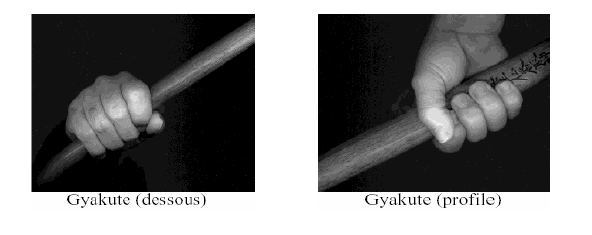
How to hold correctly with Honte
The part of the hand that truly represents the connection with the rest of the body is located in the “heel” part of the palm. This part of the hand must be firmly “joined” to the sword (or another instrument) if one wishes to find a grip that leads to the realization of the “Tai-Ken” union.
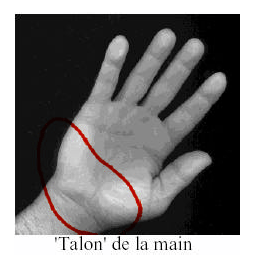
Heel of the hand
For good execution, we need first of all the little finger, then the ring finger and, finally, the middle finger. It is interesting to note (the illustration below) that only the little finger is capable of holding itself in position and that, for this reason, it requires a powerful and precise application that will be reinforced by the other two fingers.
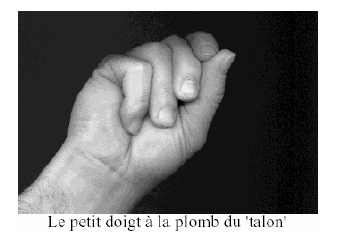
Getting into position
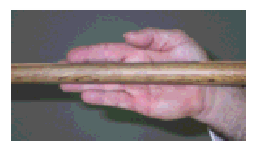
-
place your right hand flat on the back of your bokken (wooden sword) as in the illustration.
-
Then place the little finger in line with the heel of the hand, without gripping with the whole hand, thus avoiding losing contact and central alignment with the heel of the hand. This is of primary importance and must be carried out scrupulously if one wishes to develop a correct position.
-
Then place the other two fingers firmly (the ring finger and the middle finger), reinforcing the position of the little finger. The index finger and thumb will naturally take their position, but you will take care that they remain relaxed without, on the other hand, opening. They should be as in the illustration (see the illustration below).
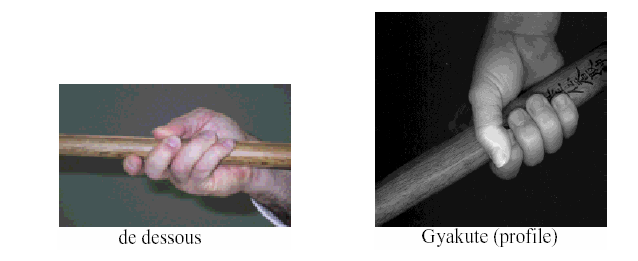
- For the left hand: place the end of the Ken in contact as for the right hand, but with the end of the Ken (Kashira: pommel) slightly forward in relation to the heel of the hand, as in the illustration.
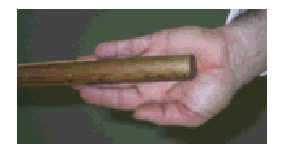
- Proceed as for the right hand, holding the little finger, ring finger, and middle finger as explained above, without gripping with the whole hand.
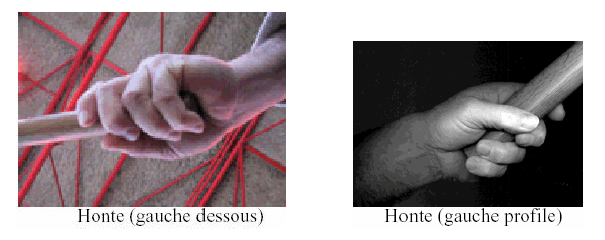
- Place both hands on the sword while at the same time respecting the hand position obtained as indicated above.
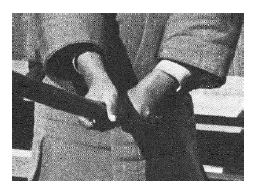
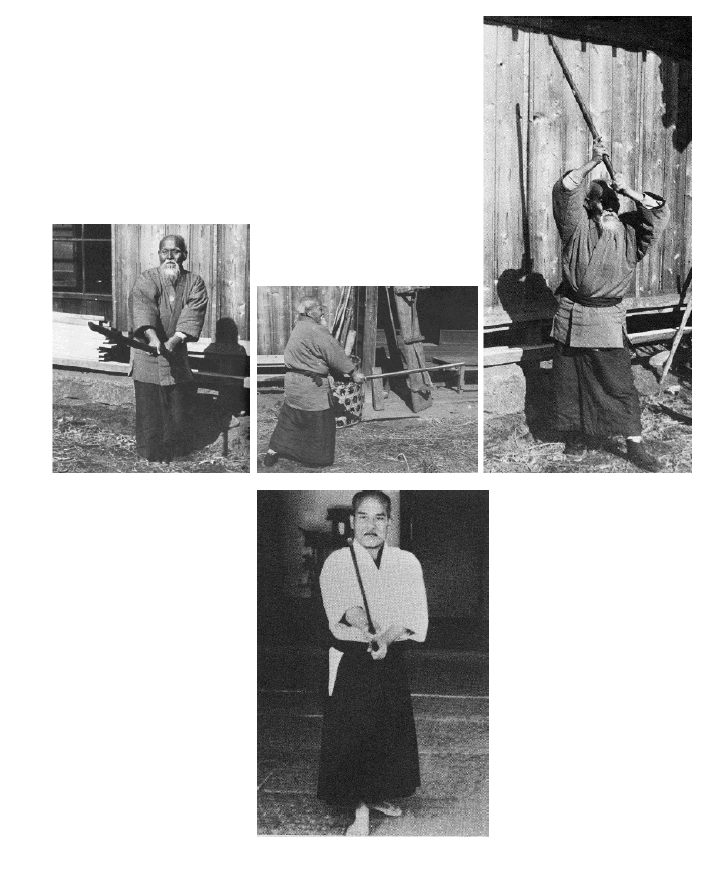
- Now that we have established the sword grip, we can place ourselves in the guard position fully united, the body in correct contact with the ground and the sword in correct contact with the body. The integrity of the body position respects both the vertical/horizontal position and the extension forward.
Look carefully at the photos of O’Sensei Ueshiba in Kamae with the bokken. When one understands, through practice, the notion of Ki Ken tai, these photos show the total integration of these three elements.
Integrating breathing - Kokyu Awase
Up to now we have seen only the static elements of KI, but it must be remembered that this principle must also be mastered in the smallest dynamic movements. At this moment the difficulties begin! In calm and stillness it is relatively simple to feel one’s vertical axis, the balance shifted forward and in extension, to place oneself in kamae, to take the sword with the hand, etc.; but the instant we make even the slightest movement that draws our attention, everything immediately disintegrates.
One no longer lives the principle! The catalyst that will allow us to pass from static practice to dynamic practice, while maintaining the Ki Ken Tai union, is breathing – Kokyu.
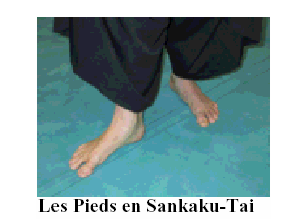
*The feet in Sankaku-Tai
- Take the guard position [Sankaku-Tai]{.underline} (Hito and Mi), checking one by one the elements seen above: center of gravity, Sei-chu-Sen (vertical axis), horizontal centering forward, dynamic forefeet, hands correctly placed on the Ken, general relaxation of the body while always emanating vitality, the sword held in Seigan (in extension toward the eyes), etc.
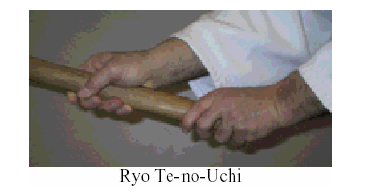
Ryo Te-no-Uchi
-
Establish calm, slow, regular, and natural breathing. At a given moment, as soon as you feel the natural rhythm of your breathing, let the sword go upward together with the inhalation, without changing anything in your posture (hands included). Have the sensation of directing the tip toward the sky. You should also have the sensation that the whole body participates – starting from the feet – in this extension toward the sky. Here it is very important not to change the position of the hands on the sword – the “honte” contact must be maintained throughout the entire movement.
-
Let the sword descend, cutting (without adding force or speed), together with your exhalation. Here you will have the sensation of finding again a rooting of the whole body to the earth (par rapport à la terre).
Conclusions
Through these simple exercises we have put into practice the fundamental elements that allow us to realize a movement that respects the principle of Ki Ken Tai:
-
The centering of the individual;
-
The correct balance of the body;
-
The perception of the Seika-Tanden;
-
The extension of oneself outward;
-
The correct contact between the individual and the earth;
-
The correct contact between the hands and the instrument;
-
The coordination of breathing with movement.
There are other factors that can be taken into consideration, but those just mentioned are the most important. One must always remember that it is necessary to perfect this work through diligent and regular practice of the discipline. Once Ki Ken Tai has been made vital within oneself, it will be applicable to all the activities of one’s life.