One should never write, I knew it! A little editorial — up there…! And there it is! Now I have to explain myself! Add something! I will write other things that will create panic in the forums… cause a curriculum vitae embolism… I only wanted to do a favor… Write things that are already known… That Morihei Ueshiba taught bayonet technique before the war at the Police Academies, the army academies, the Naval Academy, and the espionage schools, the elite of Japanese militaro-fascism, is no secret to anyone… That he also taught, after the war, that Aikido is Love, protection of life, joy, and universal peace is no secret either… That Aikijutsu, in its first version, is a martial art, I do not doubt… I am not a complicated person; Omotokyo, I understand nothing about it, and as for Kotodama, it is probably better if I keep my opinions to myself…
“Living as a warrior” — not making war! — has it awakened memories of May ’68? Never been to war? No regrets! My old Sam 1, in the more or less official service of Her Gracious Majesty…, many jobs, bare-handed, in the Falklands and elsewhere…, never confused Aiki with war… quite the contrary! He had his ghosts… I do not. Peace to his soul!
Not long ago I saw a television report on the Foreign Legion. There was a Japanese man who had enlisted in order to go to war… He was right: war has specialists for that, real ones, who do not play with wooden swords… That man wanted to be a modern samurai; he had left Japan for the Legion, for the professionals, not for a Dojo. He had understood…
I am not violently pacifist, but I do not like war. I agree with Sun Tzu: “The best general does not need to wage war.” And I admire only one soldier: a Russian paratrooper general, Lebed, who managed to stop two wars without fighting… He was assassinated later… For the record, his bodyguards practiced Aikido…
So: living as a warrior?
To begin with, a warrior is not necessarily a military man or a soldier. Nor is it a matter of dressing up as a samurai or sleeping with a sword at one’s side… For me, since I am not the reincarnation of Morihei Ueshiba and cannot speak in his name, it is a path, a process of human evolution toward a higher stage of being.
The way of the warrior is dangerous, not because one risks being mown down by a burst of bullets in a heroic gesture immortalized by photographers, but simply because spiritual defeats are numerous and the roadside is strewn with those who have given up… This way, like all others, is marked by major stages, which I would now like to try to describe.
The fortress (paranoia 1)
The fifth column (paranoia 2)
Belly to the sun…
And punctuated by the syndrome of the Desert of the Tartars.
The fortress corresponds to a period of physical construction. One must structure the body through rigorous training and accumulate techniques. Deep foundations, thick and solid walls: nothing is left to chance, every detail is developed according to its defensive and strategic value. Beware of houses of cards or sandcastles! This is, I believe, the meaning of Saito Sensei’s teaching: to build on stable, healthy, and strong foundations.
Several of Morihei Ueshiba’s students left him, such as Gozo Shioda of the Yoshinkan, because they did not want to — or could not — take an interest in other things. It may be tempting to refer to a masterpiece of military art so carefully developed, such as, for example, the Fortress of Salses: total planning against “the other”!
It is clear that this fortification is not, and cannot be, a stage of liberation, but that one builds oneself against the world through the awareness of dualism: “I/world.” The opponent, the one in front, grabs me, attacks me… I defend myself… There is no way to escape this reality. This is characteristic of paranoia in its benign form: the world is aggression.
In this regard, there are also tensions induced by recurring speeches about harmony that do not fit, and this is normal with techniques that clearly function in reaction to an attack, an opponent. It could not be otherwise. To claim the contrary is to lie to oneself, and there is nothing more foolish, nor more dangerous, for one’s growth.
The problem is accentuated for physically “gifted” people, who may be led to believe they have already attained mastery, when they are only handling the weapons.
This physical aspect of practice is accompanied from the first day by work on the emotions, on which we dwell less simply because it is less visible, less obvious. The physical relationship with the other, or with the Earth, automatically triggers powerful and very deep emotions of fear, anguish, aggression, and so on, which our culture tends to conceal or, worse, no doubt, to regard as negative. The simple fact of being grabbed and not being able to free oneself is anxiety-inducing; otherwise anyone, without adequate preparation, could remain relaxed without being disturbed by aggression. The same is true of falls… The Earth is frightening — and sometimes painful!
Yet a warrior without fear is a dead warrior! There is nothing more useless, except perhaps to fill military cemeteries… Fear, aggression, and so on are emotions essential to life. The question, once again, is to learn to recognize them and then to work with them, not against them. The fear that pushes you to get out of the path of a truck is a good adviser. The fear that makes you close your eyes so as not to see it is murderous. In the first case, there is communication with the emotion; in the other, invasion, excess, loss of control and, above all, loss of freedom. Yet, fundamentally, it is the same emotion.
This double work, physical and emotional, is the very nature of the fortress.
If all goes well, the day comes when one asks the question: “What is all this for?”
Indeed, I believe that the number of those who have had to use Aikido techniques in their daily lives is derisory. I have no statistics. It is clear that shutting oneself in harms only oneself, and that no bloodthirsty enemy bellows in our countryside…
This is the syndrome of the Desert of the Tartars!
“Is my beautiful fortress an absurd monument erected against emptiness?”
Doubt insinuates itself: has all this therefore served no purpose? Are these beautiful walls of which I am so proud perhaps useless? Is my beautiful fortress an absurd monument erected against emptiness?
This questioning drives many to give up… Some resolutely shut themselves into obtuse certainties; others, more deeply undermined by doubt, set out in search of a new enemy… If nothing comes from outside, then there must at least be an enemy inside my beautiful fortress, a fifth column, a far more insidious enemy, dangerous, an invisible traitor!
Everyone knows it as “Ego,” the evil beast… And here is our castellan setting off to hunt the ego with the same enthusiasm he once devoted to keeping watch before the steps of the empire… The scoundrel is well hidden; the fortress overflows with hiding places, trapdoors, cellars, underground passages, secret corridors, dark zones… There, no glittering cavalry, no trumpet blasts, no vain dreams of glory. No! One must crawl silently through the cold mud of obscure tunnels…
It is a long and exhausting search that tests patience and corresponds to a more advanced form of paranoia: the enemy is no longer only outside, it is everywhere — world/me, everything is enemy, and this pressure is enormous… It is possible to inspect every speck of dust, but none hides the ego…
Over time, the syndrome of the Desert of the Tartars returns with force… No enemy has ever appeared from outside; no enemy appears inside… And doubt insinuates itself, more terrible, more devastating. Doubt is like a riddle at a crossroads… I cannot have been wrong to this degree… I must continue at all costs.
Attachment to what the fortress represents — the work accomplished, the path covered during the hunt for the ego — is a formidable trap. The danger is to shut oneself in forever, becoming at the same time jailer and prisoner. On the other side opens the nihilistic path of abandonment…
But what if, truly, all this served no purpose, led nowhere? What if there were no enemy? What if the world were not against me? What if there were not even an enemy within me? What if the ego were nothing more than a mode of expression of being, another form of emotion, useful or harmful according to the use made of it? What if the ego had become an enemy only because of phantasmatic mental projections?
It is at that point that a tremendous laugh resounds… Let us tear down the walls!
Let us go and enjoy the sun that has finally returned, a glass of wine in hand and belly to the sky…, in a world made peaceful.
The warrior’s cycle is complete.
To avoid having to return to this, it seems useful to specify that this process is not linear and that these “stages” are not truly real. The construction of the fortress and the hunt for the ego do not exclude one another; on the contrary, they are more often entangled. This does not change the fact that the path is made by immersing oneself in the world and its activity, not by denying its existence or withdrawing from it. Nor should we forget that the ego has been strengthened for a long time before laughter disperses the shadow of the walls; this explains the behaviors at the opposite pole of “harmony” that everyone can observe in more advanced practitioners and, for that reason, those more exposed to the traps of the Way. If one day we find ourselves “belly to the sky,” it will be through experience, not through speeches.
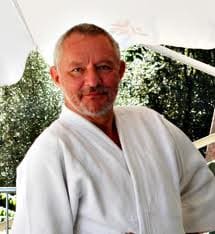 This is my understanding of Aikido after forty years of practice. That does not mean that tomorrow I will not regret what I have let slip here.
If this vision of Aikido interests you, I allow myself to recommend a small book: Shambhala by [Chögyam Trungpa]{.underline} (Ubaldini Editore), in my opinion the most interesting perspective on the spiritual warrior in modern society. I would call it the best Aikido book I know.
Barcelona — February 2006
Translation by Valeria Glingani and Daniel Leclerc
Original French version in PDF:
Footnotes
-
Sam Noyce, well known to older Italian practitioners and a great friend of Stéphane. ↩