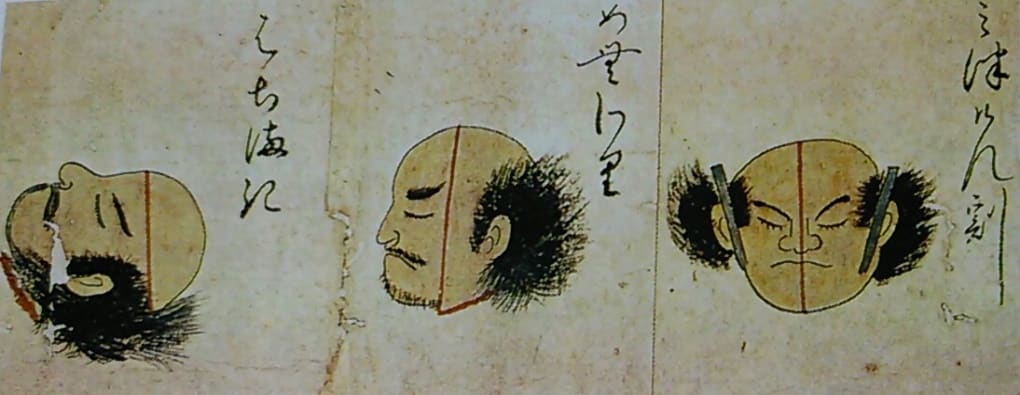
Tameshi-giri and Suemono-giri

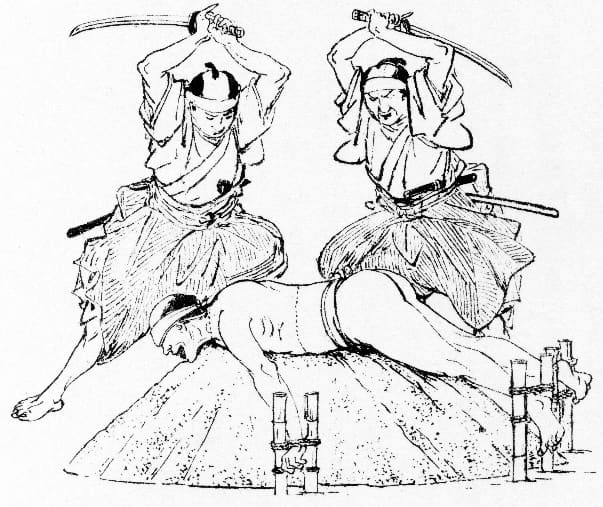
“Tameshi-giri” (or “suemono-giri”) were “cultural practices” of the samurai class in feudal Japan, in which targets were used as a means of testing the quality of swords or the skill of swordsmen.
Although the term tameshi-giri in modern martial vocabulary refers to “a method of training in the use of a sword by cutting conventional targets,” the original socio-cultural meanings that marked it as a custom, as well as its social functions within the structure of premodern Japan, are rarely examined in depth. The purpose of this short document is therefore to offer an analysis of this ancient custom, focusing on its transformation and on its manifest and latent social functions.
“Tameshi-giri” (or “suemono-giri”), an activity in which corpses were used as “targets” in order to test the effectiveness of swords or the skill of swordsmen, was a cultural practice of the ruling samurai class during the Edo period (1603–1868). It was socially accepted and even valued until 1871, and when the Tokugawa shogunate came to an end in 1868 such a brutal practice had already officially ceased to exist. Eight years later the new government also officially decreed the prohibition against wearing swords in public.
However, although almost 150 years have passed since the disappearance of this unusual custom, the Japanese term “tameshi-giri”, used in martial jargon to refer to a particular kind of training in sword use, is still widely used today, including in the Western world. Today the term “tameshi-giri” is generally used to refer to the practice of cutting conventional targets such as water-soaked rolls of straw mats or bamboo, in order to test and develop skill in the use of swords. “Suemono-giri” is another Japanese term with which many Western martial arts practitioners are usually unfamiliar. It is a rather old term, and even modern martial arts practitioners in Japan do not use it very often unless the context specifically requires this narrower term, and unless they are aware of its existence. Besides having a semantic emphasis concerning the way the target to be cut is positioned — that is, whether the target is fixed or not, whether it is placed on a stand, what kind of stand is used, and so on — the term “suemono-giri” fundamentally means the same thing as tameshi-giri: both refer essentially to the same social behavior or action.
It is not surprising that the actual practice of tameshi-giri (and suemono-giri) as a cultural and social custom has changed greatly over the course of its history. Today, if a Japanese person heard either term, they would imagine a samurai of the past, or a skilled modern swordsman, performing various kinds of cuts on fixed targets made of conventional materials in order to test and develop his ability to execute proper cutting techniques with a sword. In the same way, this definition of tameshi-giri seems to be widely shared among non-Japanese practitioners who are familiar with the term and with the study of the sword. Yet, although tameshi-giri is already understood as “test-cutting a fixed target with a sword,” its historical and social functions for the samurai class, and the transformation of those functions in the feudal era, have rarely been explored.
When the feudal practice of tameshi-giri is discussed in a non-scholarly context, it often risks generating misunderstandings about its direct purposes — namely testing the quality of swords or testing the skill of a swordsman — as well as about its social behavior: maintaining the martial spirit of the warrior class, punishing offenders, and functioning as part of the institutional system of criminal justice.
Literal meanings of tameshi-giri and suemono-giri
The word “tameshi” means “test,” and the suffix “giri” means “cutting”; therefore the compound noun “tameshi-giri” literally means “test cutting.”
The word “sue-mono” means “something placed on some kind of support,” so “suemono-giri” literally means “cutting a fixed target.”
As is clear from the semantics, neither the word tameshi-giri nor suemono-giri indicates in itself “what is to be cut” or “how it is to be tested.” To understand the meanings and cultural connotations of the two terms — as individual social behavior, cultural custom, or social structure — it seems indispensable to know what they actually refer to in Japanese, since every language is a reflection of the culture itself.
The definitions of tameshi-giri given in Japanese dictionaries present interesting historical connotations, specifying both its immediate purpose, its social purpose, and the medium to be cut. According to a modern Japanese encyclopedic dictionary, the term tameshi-giri is defined as “the procedure for testing the cutting ability of swords by cutting men and animals.” In another well-known dictionary it is defined as “cutting human beings or a bundle of rice straw in order to test the sharpness of swords.” In yet another dictionary it is defined as “cutting dogs, cats, or human beings in order to test the cutting ability of swords.”
In none of these dictionaries, however, is there a definition for the term suemono-giri.
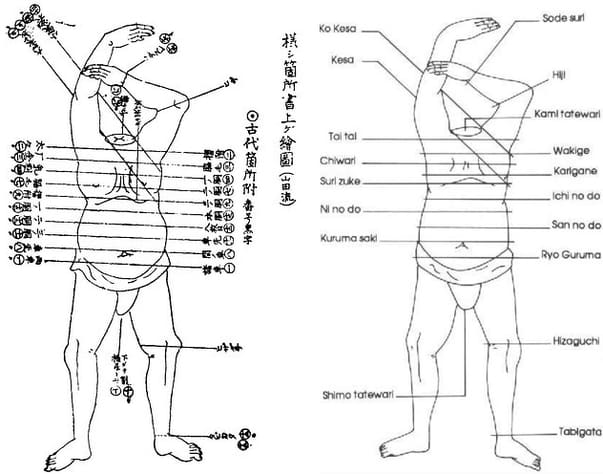
Historical connotations
While the semantics of the two terms do not indicate the immediate purpose of the action, the three dictionaries clearly define tameshi-giri according to its intended purpose: “testing the cutting ability or quality of blades,” rather than the swordsman’s skill. The definitions provided by all three linguistic dictionaries even specify a common cutting target: human beings, although they do not specify whether they were corpses or still alive.
Naturally, in modern Japanese society, cutting human beings, whether living or dead, in order to test the quality of swords is legally and morally condemned (…there are no longer any good old-fashioned Japanese people…). Today there is in fact a common awareness that the practice of tameshi-giri is devoted exclusively to cutting targets made from conventional materials in order to measure a swordsman’s skill rather than to evaluate the quality of swords.
As we have seen, modern Japanese dictionaries still essentially define tameshi-giri as “testing the quality of swords by cutting human beings.” The most logical explanation is that, in the age of the samurai, this practice did in fact mean precisely “testing swords by cutting human beings.” We must first of all bear in mind that historically, from the end of the so-called Warring States period to the beginning of the Edo period, the right to carry swords was a cultural and legal privilege granted only to members of a specific ruling social caste, in order to symbolize certain values or to serve certain social functions relevant to that caste.
It is not easy to identify documented cases of tameshi-giri (or suemono-giri) in written historical records before 1500, since many documents from before the Muromachi period were lost or destroyed by fires during the long Warring States period (1493–1573). Written documents after the Battle of Sekigahara in 1600, however, tend to be much better preserved, or were even reprinted, making research and analysis easier.
From the mid-1600s onward, records of such practices begin to appear frequently both in historical documents and in national and local public records, as well as in the writings of private authors, although the word suemono-giri does not appear as often. In those documents, simpler words for “tameshi-giri”, such as “tameshi” and “o-tameshi” — that is, an honorific form of “tameshi” when performed by a high-ranking samurai — were used to indicate “test cutting on human beings in order to maintain the honorable martial skills and spirit of samurai warriors.” It is interesting to note that those documents do not specify tameshi or o-tameshi as a test of sword quality, but rather tend to emphasize their purpose in maintaining martial skills and spirit. One such seventeenth-century document, used by the Department of Literature and Books of the Tokugawa Shogunate as a record of sentences issued by daimyo — the provincial rulers to whom the shogun gave full governing authority — documents that Hosokawa Tadaoki (1563–1645), the first lord of Buzen Kokura province, performed his first o-tameshi on nine corpses when he was only fifteen.
Hosokawa Tadaoki’s son, the second lord of Kokura province, is also documented as having performed o-tameshi at Nitcho. It is also established that two sons of Tokugawa Ieyasu, both born shortly after the Battle of Sekigahara and later rulers of their own territories, performed “o-tameshi” on a common-class servant who had committed a crime, and on the corpse of an executed criminal within their jurisdiction in the early 1600s.
A document written in the 1600s by a private author records that Horio Tadaharu (1599–1633), the third lord of Izumo province, was strongly in favor of the practice of o-tameshi. The Hagakure, written in 1716 by Yamamoto Tsunetomo, a retired samurai of Saga province, likewise describes how Nabeshima Katsushige (1580–1657), when he was young, performed tameshi-giri on ten human beings by order of his father.
In documents drafted between the mid-1600s and the early 1700s, the popularity of tameshi-giri among financially well-off samurai is well documented. For example, in the seventeenth century the Hennen tairyaku, the official document of the Owari provincial government, records that in 1667 several corpses of executed Christians were assigned to samurai officers for use in tameshi-giri. This document implies that at the time tameshi-giri was a very common practice among the samurai class, and that corpses of executed criminals were formally delivered for this purpose. Further cases from the mid-1660s can also be found in Histoire de la religion chrétienne au Japon, a book written by the French diplomat and writer Léon Pagès, who translated many historical documents relating to the presence of Christians in Japan. In Nara province in the mid-1600s, the official register of the criminal courts — the office of the Nara magistrate from the seventeenth to nineteenth centuries — also records the use of the corpses of executed criminals for tameshi-giri.
To show how popular tameshi-giri was in Japan during the 1600s, the Zoku Henro-ki, a private diary kept by a samurai of Echizen province at the end of the seventeenth century, describes how the servants of a samurai devoted to tameshi-giri searched rivers for the corpses of drowned people for their master. In confirmation of what is described there, the provincial government of Kaga officially issued an order in 1661 forbidding anyone to collect the corpses of drowned people, or of those mortally wounded along the roads, for the purpose of tameshi-giri… unless… they had been authorized by the local magistrate’s office. Similarly, in the official register of the Aizu provincial government, there is evidence of a new formal procedure officially promulgated in 1660 concerning the use of public facilities specifically dedicated to tameshi-giri. According to this official act, the new procedure had to be followed by all members of the samurai class of the province, from the lowest rank to the highest-ranking officers. This clearly suggests that in Aizu province — famous for its strong military and warrior spirit — this kind of practice was extremely common and popular among samurai of all ranks. The popularity of tameshi-giri as part of an integrated system is also well documented in a private diary kept by a high-ranking samurai official of Owari province (Asahi, 1691–1718).
During the 1700s, the Tokugawa government established a period of peace and social order, placing great emphasis on the education and moral behavior of the ruling samurai class, to whom the common class still had to show absolute respect. As a consequence, the popularity of tameshi-giri among the samurai class began to decline markedly. In the eighteenth- and nineteenth-century volumes of the Tokugawa shogunate — the earlier of which had proudly recorded the practice of o-tameshi by high-ranking daimyo born before or shortly after the Battle of Sekigahara — stories began to be recorded of merciful daimyo who abandoned the practice of o-tameshi after receiving a sermon from a monk, or who pardoned criminals who were about to be executed.
Reflecting the nationwide decline of this practice, the author of the Hagakure complains in the 1700s that the younger generations of the warrior class were making excuses not to perform tameshi-giri. In a very similar complaint, a samurai of Shonai province in the early 1700s states that, despite the complaints of young samurai who criticized tameshi-giri as brutal and crude, especially in a historical period in which society had been pacified, there were no other ways to maintain a proper martial spirit and constant technical readiness than actually using swords on criminals condemned to death. The overall decline of the practice of tameshi-giri among the new generations of samurai is also reported in the Hachiju ou mukashi-banashi, an essay written in 1732 by an eighty-year-old retired hatamoto officer of the shogun’s army. In retrospect, the author states that during the years 1660–1670 common-class household servants caught committing crimes in their master’s mansion were used as instruments for tameshi-giri, but in more recent years — that is, the 1720s–1730s — such things had become very rare.
In some historical documents from the 1700s, cases of tameshi-giri are recorded mainly in the context of judicial acts. During the same period, most official journals and registers of provincial governments, which were kept up to date until the end of the Edo period, began to mention this kind of practice only briefly. This tendency in the records continued into the 1800s.
The words “suemono-giri” and “suemono” appear much less frequently than “tameshi” or “o-tameshi”, but they begin to appear more regularly from the mid-1700s through the 1800s.
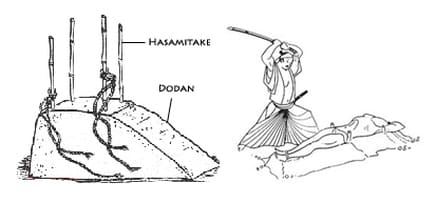 In particular, when the term “suemono” appears in historical documents, it mostly refers to a specific form of “tameshi” in which the corpse of a person condemned to death is placed on a raised earthen platform (dodan) to be used as a target. The word “suemono” was also used to form compound nouns such as “suemono-shi”, meaning an expert or professional in “test cutting of stationary targets,” or “suemono no waza”, meaning “test-cutting techniques on stationary targets.” The term suemono-shi — professional performers of tameshi-giri — begins to appear increasingly often in historical documents in the 1700s, when the cultural practice of tameshi and o-tameshi was clearly beginning to decline, until by the 1800s it had become contextualized almost exclusively within criminal procedure after executions.
In the jurisdiction of the capital Edo, tameshi and o-tameshi were entirely entrusted to the Yamada Asaemon family, who were already professional sword testers specializing in test cutting on corpses and even on living criminals on behalf of the Tokugawa shogun and other nobles of the highest rank. Since by the 1800s tameshi-giri was now performed by professional suemono-shi, or by samurai commissioned by the government or local governorships, there would no longer be any written reports of privately performed o-tameshi.
The Tokugawa shogunate was replaced in 1868 by the Meiji government, which in 1871 abolished the four social castes — the samurai, farmers, artisans, and merchants — declaring equality among the four categories. In 1876 it also issued the prohibition against wearing swords for anyone who was not an active-duty military officer or police officer. With this ordinance of the new imperial government, the samurai warrior class that had ruled Japan for almost 700 years was completely abolished.
If we now examine the records reported in historical documents, four historical phases of transition can be observed:
-
the pre-Sekigahara era (before 1600), in which tameshi-giri is presumed to have been practiced regularly among the samurai class during the Warring States period;
-
the era from the early 1600s to the early 1700s, in which tameshi-giri and o-tameshi were very popular among high-ranking samurai;
-
the era of decline (from the mid-1700s to 1876), in which tameshi-giri came to be regarded as cruel and samurai who practiced it as inhumane, and in which high-ranking samurai no longer performed o-tameshi privately;
-
the modern era, in which tameshi-giri is reintroduced as a form of training within the martial arts.
In each of these phases, the direct purposes of the behavior, as well as its symbolic meanings and social functions, appear to be different, because the role and function of the samurai class changed over time. Its immediate purposes, symbolic meaning, and social functions therefore need to be analyzed within each of the four historical phases.
The fact that we have well-documented sources reporting that daimyo of the early Edo period performed o-tameshi strongly suggests that, for samurai of the pre-Edo period, especially during the Warring States era, the practice of tameshi-giri was very common… also because battlefields constantly provided the means and the opportunity.
Since the samurai class was constantly engaged in battles, it is not difficult to imagine that tameshi-giri served not only to test the quality of swords, but also to test the physical and mental skills involved in their use. From a tactical point of view, on the battlefield samurai obviously wore armor and used swords only as sidearms. The enemy soldiers they wanted to defeat were not only armed in the same way, but also had the annoying tendency to move rather than remain posed as static targets. It follows that the immediate purpose of tameshi-giri on corpses was only to test the quality of blades and the physical skill involved in using them, since cutting unarmored corpses is certainly different from trying to cut armored moving targets who are trying to do the same to you.
In this sense it seems more reasonable to suppose that tameshi-giri during the pre-Sekigahara period was mostly performed as psychological training to overcome the fear of cutting living human beings on the battlefield. This practice, popular among relatively well-off samurai, was perhaps also something similar to sport hunting: although those who enjoy sport hunting no longer need to hunt for food in order to survive, they still enjoy the activity as part of a physical and mental exercise. 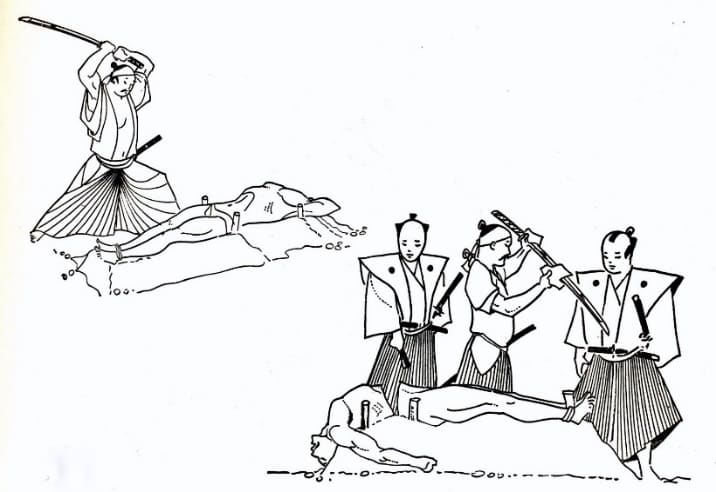 From the mid-1700s to 1876, during the era of samurai decline, the immediate purpose would have changed from testing mental and physical skills — now seen as cruel and inhuman — to testing the quality of swords. After tests performed by suemono-shi, all the details of the test were proudly recorded on the tang of the blade (nakago): how many corpses the blade had managed to cut, which part of the body had been cut, and how effectively.
For members of the samurai class, the collective feeling and martial spirit of the warrior were extremely important. Besides being professional warriors, they represented the ruling class of the country, and their swords were the symbolic representation of their martial spirit: duty, responsibility, and obligation. The practice of tameshi-giri therefore clearly symbolized their effort to maintain an “honorable martial spirit,” proper attitude, and correct mental approach. Its execution on the corpses of criminals also symbolized their status as a ruling class, representing military authority and criminal justice, thereby performing a function in stabilizing the social order. It is not difficult to imagine, in fact, that publicly displayed tameshi-giri had deterrent effects on criminals, or potential criminals.
Once the belligerent period had ended with the Battle of Sekigahara, the new shogunate tried to restore social order and stability by emphasizing the loyalty, duties, and responsibilities of the samurai class, while at the same time placing great emphasis on the educational and moral impact of martial arts for the warrior class. During this period, the popularity and spread of tameshi-giri must also have served the latent function of a safety valve through which the new generations of samurai could vent their frustrations while maintaining their collective social identity as a warrior class… as well as having a latent function of entertainment.
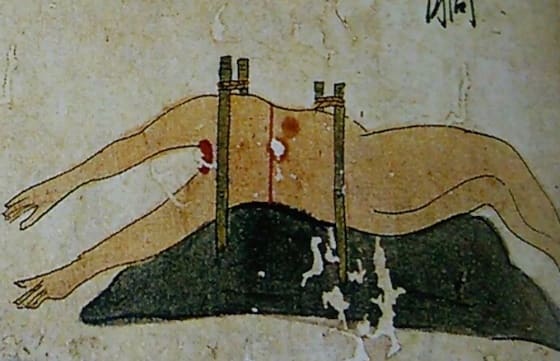
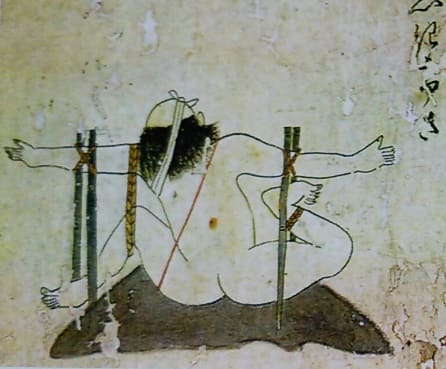
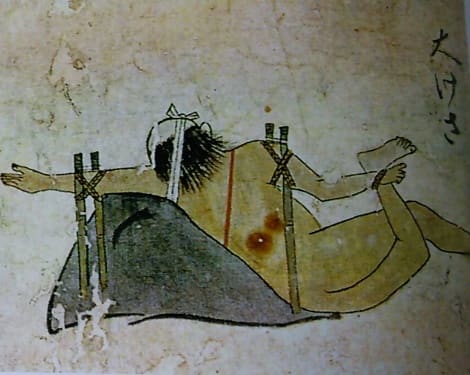
The notion of tameshi-giri performed as a legitimate element of criminal justice is clearly shown in many historical documents written between the mid-1600s and the early 1800s — for example in Aizu province documents from the seventeenth to nineteenth centuries, Fujita 1870, Hachiya 1814, Kodera 1724, and Nara records from the seventeenth to nineteenth centuries — which describe the specific procedures and ritual and formal details of public executions. It also seems that in the judicial system of the Edo period this was the norm rather than the exception, at least until the late 1700s and early 1800s. Unless they were exempted for some reason, the corpses of executed criminals were always used as instruments for test cutting, as part of the capital punishment itself.
From the mid-1700s onward, the shogunate and provincial governments began to modify criminal laws in order to compile a list of exemptions from this practice, based on social class, the gender of the criminals, or the gravity of the crimes they had committed. Between the late 1700s and early 1800s, the Tokugawa shogunate and several provincial governments therefore issued prohibitions formally listing the following categories:
-
Samurai or clergy — in shogunate jurisdictions;
-
Female criminals — in the jurisdictions of the shogunate, Owari, and Takasaki provinces;
-
Criminals condemned for manslaughter rather than premeditated murder — in the jurisdiction of Hiroshima province;
-
Criminals with visible skin diseases — in the jurisdictions of the shogunate and many provinces.
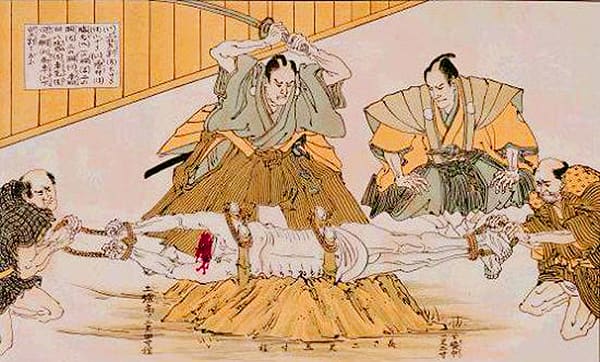 In the 1600s, the samurai class still maintained a strong warrior-class mentality, and also tried to preserve the martial skills necessary for its primary role. Although there are few references in historical sources before the Edo period (1603–1867), it is clear that by the early 1600s this practice had already been sanctioned as an approved means of testing the quality of swords.
During the first phase of the Edo period, many high-ranking samurai, including daimyo, were in fact involved in the practice of o-tameshi, since in their warrior-class subculture it was considered an absolutely legitimate and necessary practice.
Some of the daimyo documented in historical records as having performed o-tameshi on living criminals or corpses include:
-
Tokugawa Yorinobu, son of Tokugawa Ieyasu and first lord of Kii province (Miura, seventeenth century; Tokugawa shogunate, seventeenth century);
-
Tokugawa Yorifusa, another son of Tokugawa Ieyasu and first lord of Mito province (Tokugawa shogunate, seventeenth century);
-
Tokugawa Mitsukuni, son of Tokugawa Yorifusa and second lord of Mito province (Tokugawa shogunate, seventeenth century);
-
Nabeshima Naoshige and Katsushige, the lords of Saga province, father and son (Yamamoto, 1716);
-
Honta Masakatsu, lord of Kohriyama province (Tokugawa shogunate, seventeenth century);
-
Hosokawa Tadatoki and Tadatoshi, the lords of Kokura province, father and son (Kokura province, seventeenth–nineteenth centuries; Tokugawa shogunate, seventeenth–eighteenth centuries);
-
Horie Tadaharu, lord of Matsue province (Neiko-sai, 1600).
Despite the samurai’s efforts to maintain their martial spirit and identity, the long period of national pacification, together with the wave of civilizing reforms, clearly began to influence daily collective mentality and customs. The samurai were no longer a true warrior class, but had mostly become a privileged class of government bureaucrats.
From the volumes kept by the Tokugawa shogunate in the eighteenth century, we learn that, because the samurai no longer needed to maintain the characteristics of a warrior caste, o-tameshi had become much less popular by the mid-1700s. During this period of decline, professional sword “testers” began to appear — not ordinary executioners — called “otameshi-geisha” or “suemono-shi”: lower-ranking samurai with recognized skill in swordsmanship, who performed o-tameshi on behalf of high-ranking samurai. By the mid-1700s, the Tokugawa shogunate and its Osaka and Nara bugyo-sho — that is, district magistrate offices — as well as the provincial governments of Aizu, Owari, Saga, and Satsuma, some of whose lords had been famous for practicing o-tameshi until the mid-1600s, all began to employ a professional otameshi-geisha or suemono-shi to test the swords of high-ranking samurai in their place.
One matter in which an incorrect belief often persists concerns whether the hinin, executioners of the lowest social caste — hinin literally means “non-human” — performed tameshi-giri or not. This is usually caused by two preconceptions: the first is the awareness that by the late 1700s many high-ranking samurai had stopped performing o-tameshi; the second is that hinin were used as attendants in penal institutions. According to historical documents, even after the practice of tameshi-giri had come to be considered uncivilized and inhuman, decapitation and the cutting of corpses to test the quality of swords were still conducted, and actually performed, by professionals and never by the hinin. The latter were instead used as assistants for transporting, moving, and arranging corpses on the dodan, and as attendants to clean the grounds.
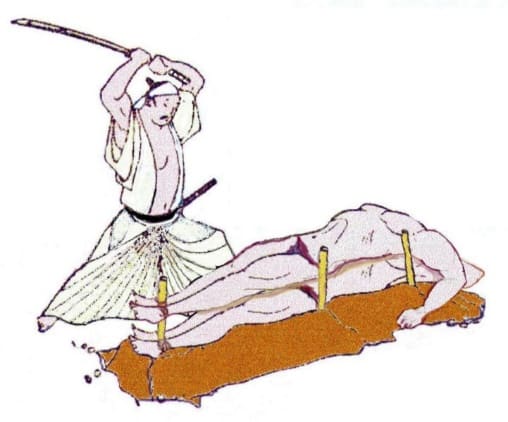 Besides what is shown in the documents, there were at least two obvious reasons why samurai would never have allowed the lowest rank of the caste to test and handle their precious blades. One was the existence of fairly strict and detailed legal requirements imposed by the shogunate and local governments for the correct procedure of these rituals. The other was that, since tameshi-giri was performed as an integral part of legitimate criminal justice procedure — that is, as an additional punishment beyond simple execution — it was subject to regulations that clearly indicated that the actual performers could only be qualified samurai, through the observance of specific ritual procedures.
Those actually authorized to carry out the decapitation of criminals and the practice of tameshi-giri could therefore be:
a. the doshin samurai class, that is, the lowest-ranking criminal justice officers, who were considered skilled in the use of the sword;
b. professional “suemono-shi” — freelance sword testers, though still members of the samurai class — commissioned by the magistracy or directly by the owners of the swords to be tested.
The other reason why members of the hinin class could not be allowed to handle swords was the symbolic meaning of swords for the samurai class. In many cases the swords to be tested were family heirlooms or rewards granted after special assignments or promotions in rank, and therefore represented the social status and identity of their owner.
The swords to be tested were therefore first handed to the bugyo — the chief magistrate officer — then to the yoriki — the deputy chief — and finally to the doshin or professional suemono-shi who materially performed the executions. They were never placed in the hands of assistants from a lower social class.
Although most testers held a relatively low rank in the bureaucratic and social hierarchy of the samurai class, they often trained in suemono-giri schools — schools specializing in cutting fixed targets for the purpose of tameshi — which had students entirely dedicated to perfecting suemono-giri skills. When the swords to be tested belonged to high-ranking samurai, the owners of such precious blades would not have trusted family heirlooms or valuable awards to the hands of inexperienced “testers.” One of the first documented professional tameshi practitioners in the early Edo period, Nakagawa Saheita Shigeyoshi, was a high-ranking hatamoto samurai — that is, an officer assigned to the shogun’s military force — with an estate of 1,200 koku, that is, barrels of rice per year.
From an economic point of view, salaries in the Edo period were not high. With very few exceptions, such as Nakagawa Saheita, his student Yamano Kanjuro/Kaemon — the teacher of the first-generation Yamada Asaemon — and the famous first-generation Yamada, the “Kubikiri” Asaemon, though not the later generations of Yamada Asaemon, all seem to have received relatively modest salaries and not especially prestigious official ranks, even though their profession was still highly respected.
Combined with the general decline in demand, some heirs of martial arts schools engaged in the production of medicines by extracting certain biochemical essences from the kidneys of corpses used for tameshi-giri. Thanks to this secondary family activity as pharmacists, the Yamada family, for example, maintained a certain wealth until the end of the Edo period, even though they remained ronin, that is, samurai who had no particular lord as master and held no permanent administrative position in government offices.
The Yamada family continued its monopoly as commissioned sword testers for the shogunate until the Meiji Restoration, when the new registration act implemented by the imperial government in 1873 replaced the old Edo-period system of appointments still based on the four classes: samurai, farmers, artisans, and merchants. The eighth generation, Yamada Asaemon Yoshitoyo, and his younger brother Yoshifusa both became prison officers in the capital Tokyo, although both were registered as heimin — commoners — and not as “shi-zoku”, the new social category created for the old samurai class, because they held no official rank in the offices of the old shogunate.
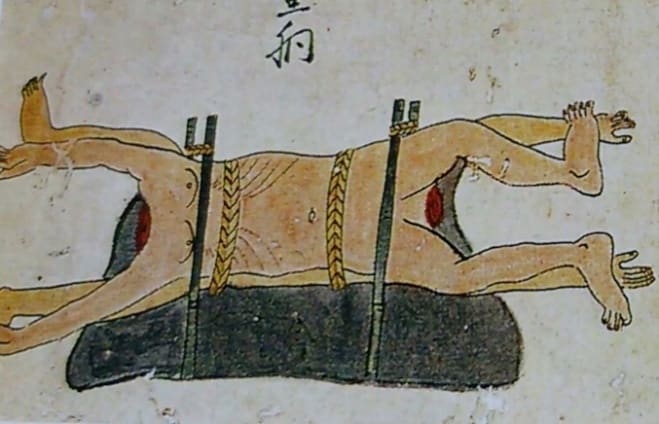 As already mentioned, sword testers did not always have the “true” testing instrument — that is, corpses — available for their daily training. It is therefore not difficult to imagine that those who specialized in that activity mainly practiced their suemono-giri skills by cutting other normally available targets, such as water-soaked bundles of rice straw, rolled straw mats, or bamboo, which approximate the weight and density of human flesh.
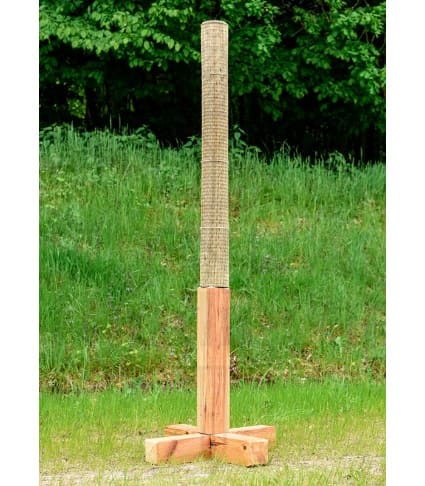
Today, Japanese sword schools that also emphasize practical applications introduce the modern notion of tameshi-giri as a test of skill, as well as a means to perfect one’s expertise in performing the manifest function of using a sword. In this case, the meanings of tameshi-giri and suemono-giri are obviously different from what they meant for the samurai class in feudal Japan.
In the current martial arts definition, although each sword school may place a slightly different emphasis and interpretation on it, the practice of tameshi-giri refers primarily to “test cutting a commonly available target, supposed to simulate human flesh and bone, in order to evaluate the swordsman’s skill and as a means to develop the abilities required to cut with traditional Japanese swords.” The only exception to these modern notions, where the term tameshi-giri still refers to “testing the quality of swords,” is the situation in which swordsmiths, or martial arts practitioners commissioned by them, test the quality of blades before they are sent to their new owners.
Despite the modern and widespread use of the term tameshi-giri in the martial arts community, the word, as defined in modern Japanese dictionaries, still carries the old notions of “testing swords” and “the use of human beings as a cutting medium.” Because of its historical mutation, and in order to avoid confusion about the symbolic and social meanings involved and to clarify its immediate purposes — that is, whether it is used to test the skill of swordsmen or the quality of blades — other terminology has sometimes been introduced. According to Toshishiro Obata, a descendant of samurai and headmaster of a Japanese martial arts school based in California, tameshi-giri can be divided into two subcategories according to its immediate purposes as training:
-
the “shi-zan” method means the testing of the swordsman’s skill through the use of targets such as water-soaked bundles of rice straw, rolled straw mats, or bamboo.
-
the “shi-to” method means the testing of the quality of a sword through the use of harder targets, including thick bamboo and, possibly, old steel helmets.
In the latter case, by testing both the quality of the sword and the skill of the swordsman on a helmet, one returns to the original purposes of tameshi-giri as the social behavior of a warrior practice.
If the cutting of an old steel helmet is seen as a means of honoring and maintaining the martial spirit of the old warrior class, it can also be seen as the return of a symbolic meaning and as a cultural custom for keeping samurai identity alive, even though the functions of tameshi-giri and suemono-giri as social structures have long since disappeared.