Before undertaking the study of the system of ranks currently used in the discipline of Aikido, it may be useful to begin with a brief historical summary of the notion of “rank” in Japanese martial practices. At a time when the various disciplines necessarily had a practical reason for existing — that is, application in authentic combat situations — it is clear that the practitioner fulfilled his duty as a warrior by winning, or by sacrificing his life in order to win, or by losing. There were not many alternatives as far as his ability as a fighter was concerned; the notion of a ranking system based on the assessment of combat ability would have been, so to speak, nonsense. Each School, however, needed a system for recognizing the practitioner’s ability to teach and to transmit the technical, philosophical, ethical, and other structures of the School itself. This is how the Menkyo Kaiden system — “teaching license” — came into being. This system was not at all based on the practitioner’s personal effectiveness; rather, it was a certificate guaranteeing that he had completed a certain course of study within a School and that he could transmit again, according to the relevant internal regulations, that part of the curriculum which he had mastered and was authorized to teach. Recently, a certain confusion has arisen from the assumption that a practitioner holding a high-level teaching diploma must necessarily also be very effective from a combat point of view.
This distinction is fundamental if one wishes to understand the problem of historical or current ranks.
In the Menkyo system there were generally three to five certificates, and therefore the same number of levels of teachers. The first certificate was called Oku Iri — “entrance into the secrets” — and its purpose was to confirm that the student had completed the study of the basics and could therefore be considered a member of the School. This required about ten years of apprenticeship, with more than three hours of practice per week, during which one became familiar with the basic curriculum. If one were to draw a parallel with Dan ranks, one could say that Oku Iri corresponds to the level of knowledge of a fourth or fifth Dan, whereas in the classical system it was the very first qualification awarded. In principle, this certificate gave very little qualification to teach, and only in the presence of a more qualified instructor and at his request. This is the “coach”. Then came two certificates qualifying instructors: Sho Mokuroku and Go Mokuroku. Sho Mokuroku — “initial catalogue” — refers to the series of techniques one was authorized to teach; Go Mokuroku — “advanced catalogue” — represents a further enrichment of the technical curriculum. These two levels corresponded respectively to “Assistant Instructor” and “Instructor”, and to ranks situated between fifth and seventh Dan. They had to be perfectly familiar with the technical curriculum of the School and played an important role in the training of young students and in the life of the School. The certificate of Menkyo, or Menkyo Kaiden, signifies mastery, and the person who holds it is fully qualified in all aspects of teaching the School. Symbolically, it may be said to correspond to the current eighth Dan. Nothing more will be added here regarding the qualifications of the Menkyo, except that at this point, if the School considered it necessary, the holder could open his own Dojo or School. Mastery, in fact, implied a certain freedom of action. The Kyu – Dan system — Kyu: class; Dan: grade — is a relatively recent invention in the disciplines known as Shin Budo, or “new martial ways”: disciplines born during or after the Meiji Restoration of 1868, generally with pedagogical and sporting aims, such as Judo, Kendo, and so on. They were contrasted with the Ko Budo, or “ancient martial ways”, of feudal origin. The system dates from the period between the late 1800s and the early 1900s. It became popular above all thanks to Judo and Kendo. This ranking system is inspired by a neo-Confucian philosophy called Chu Hsi, after the Chinese philosopher of the Sung dynasty, twelfth century. The central concept of this form of Confucianism is based on the duality Yukei – Mukei, literally: “what has form and what has no form”. One says, for example, Mudansha – Yudansha, meaning “practitioners without a Dan rank and practitioners with a Dan rank”. On the other hand, throughout the modern disciplines we find this duality again in the concepts that the practitioner must express through practice, both on the mental and on the physical level. This conjunction of “action and inaction” is called Sei To Do. Other aspects of this contrast are found in concepts such as Yuken no Muken, “confrontation and non-confrontation”; Tai to Yo, “essence and function”; Ki to Ri, “energy and reason”; and so on.
A text drawn from the writings of Master Donn D. Draeger — one of the most qualified historical researchers on Japanese Budo of our time — explicitly summarizes a situation that we can observe as extremely widespread today:
 “One difference that may be noted between the Menkyo system and the Kyu – Dan system concerns the relative integrity of the ranks. In the Menkyo system, ranks place great importance on the preservation of tradition, and the Schools (Ryu) make considerable efforts to preserve the most serious possible value at the level of teaching certificates awarded to practitioners. This is reinforced by discouraging the pursuit of ranks. Kyu – Dan ranks often lack integrity because they are often awarded for reasons other than the practitioner’s real technical ability. Thus they become a source of discord and internal struggles within a discipline, caused by ambitious people seeking titles and prestige. Modern disciplines too often attach excessive importance to ranks. The result is that the aim of training becomes the acquisition of ranks, by whatever means. Often it is the individual who chooses to present himself and apply for the rank he would like to obtain. This is made possible by the tolerance of examination panels in evaluating the techniques required to obtain the requested rank”.
Whether or not this represents the “Original Spirit” of those who created the Kyu – Dan system, we are nevertheless obliged to consider that today it forms part of it. In any case, one may consider that practitioners who race after ranks ignore the deeper aims of Budo, because when one is conscious of those aims, the acquisition of ranks becomes secondary. When the disciplines were opened to the public, it became necessary to establish a system for recognizing the technical ability, not necessarily the teaching ability, of every student, and at every level. The total absence of real combat situations, where life and death were at stake, allows the individual to be evaluated within the context of the group — something that in the past had no meaning, but that today is confused with the ability to teach. This is made even more true by the fact that the founders of modern disciplines encouraged their broad dissemination throughout the world. The existence of competitions also contributes to confirming the usefulness of the Kyu – Dan system in the spread of those disciplines, all of which adopted it in order to recognize their practitioners. To understand better the raison d’être of the Kyu – Dan system, it would be interesting to dwell on the very strict concepts of hierarchy in Japanese society. It is enough to remember that this people, from a cultural point of view, is very attached to the “title”, the “reward”, the “recognition”, and the “gift” as ways of placing the individual within society, and that the Disciplines are perceived and structured according to the model of Japanese society.
Ranks in Aikido, as in other disciplines, were established by the Founder Morihei Ueshiba. O’Sensei, as we know, evolved spiritually during his life and, in parallel, his points of view also changed. It is equally clear that, at no period of his life, were material or organizational problems of particular concern to him. The granting of ranks generally took place according to the inspiration of the moment and depended solely on his authority. O’Sensei never personally received the Menkyo Kaiden of Daito Ryu and therefore, strictly speaking, at that period of his life he did not have the authorization to award ranks in that School. The matter is not entirely clear, however, since some elements indicate that, despite the fact that he did not possess a Menkyo, he nevertheless had the right to award ranks. This is typical of situations found in the historical records of Japanese Budo. As far as current knowledge is concerned, it is certain that O’Sensei received from Takeda Sokaku Sensei, Soke — headmaster — of Daito Ryu, the certificate of Goshin’yo no Te, the highest rank awarded at that time, preceding the Menkyo Kaiden. We know that he conferred the Mokuroku of Aikido on some of his earliest disciples and gave others a copy of his book “Budo Renshu”, which functioned as an authorization and instructor’s certificate. In 1931 O’Sensei opened the Kobukan Dojo. From then on, there were instructors who began teaching outside the Dojo and who needed official ranks; it was at that time that Dan ranks began to be awarded. The Kyu – Dan system, however, was formalized only after the foundation of the Aikikai in 1948. It is clear that Master Ueshiba considered the eighth Dan to correspond to the old Menkyo, and therefore awarded it to his best disciples, both before and after the war. Some ninth Dan ranks were also distributed to people he liked or to those who had requested them. There is, however, one thing we must always keep in mind: precisely because of his spirit of non-attachment to material considerations, the question of granting ranks to his great disciples — that is, determining who really received what, when, and why — will never be perfectly clear. At the same time, through his example, he leaves us a valuable teaching on what our attitude toward ranks should be: the system exists, it is adopted by Aikido throughout the world, but our attitude should be that of a spiritually free human being, guided by a spirit of non-attachment. This, then, concerns the philological part…. “The sparkling wine is already chilling!” This expression, which one often hears, means that an examination has been prepared so well, with such an appropriate period and intensity of training, that the candidate’s level is already equal to the rank for which he is presenting himself; the examination is nothing more than a formality and, therefore, the sparkling wine is already cooling to celebrate the occasion.
I think this is the state of mind with which one should present oneself for an examination. This state of mind, however, implies prior work of particular duration, commitment, and intensity. More than a formality, the examination is an experience, a test, sometimes long, difficult, and tiring. The psychological tension of an examination gives the practitioner the opportunity to work in an atmosphere different from the one known during training. As the name itself indicates, an examination is a moment in which a practitioner is examined — his attitude, his knowledge, and his possibilities — in order finally to decide whether his overall level meets the criteria established by the responsible organization.
What is usually asked of the candidate is, all things considered, quite simple:
-
an accurate execution, without hesitation, of the required techniques, in the order given and without omissions;
-
an attitude in accordance with the various principles inherent in the study of his discipline.
Any failure to respect these points should be enough to justify asking the practitioner for an additional period of preparation. To some practitioners these criteria still seem too severe… it is therefore time to ask the question: “how far must one go?” In the distant past in Japan, this kind of test often ended with the death of one of the two protagonists. Later, protections were adopted, but the tests still resulted in serious injuries. Later still, it was decided to test only predetermined forms (Kata), which were indicated to the candidate a few moments before the test. Today we have reached the point of preparing, well in advance, a defined curriculum with no surprises, composed of predetermined techniques that are part of the training curriculum and therefore have already been practiced for a long time. It is easy to joke about the next concession: the practitioner could be given three attempts and the best one would be chosen… unless it is decided to award ranks merely in relation to the number of training sessions attended, with no other form of evaluation… And on the day when the Dojo overflow with X Dan, perhaps colored Dan ranks will have to be invented…?
If one wants a rank to inspire a minimum of respect, both from the person concerned and from others,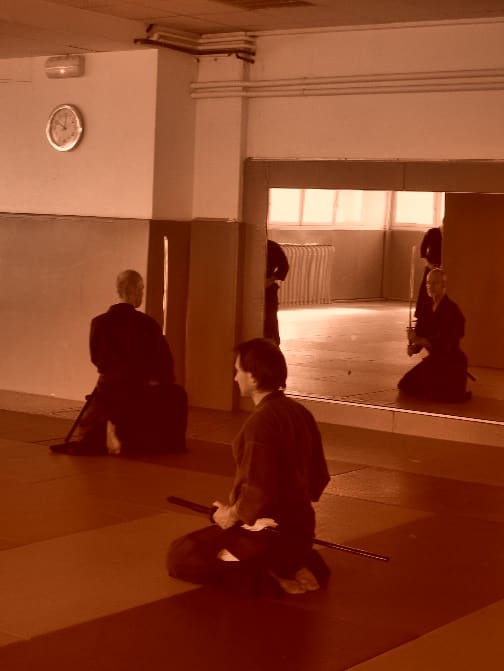 it must retain a certain value. The candidate’s responsibilities are limited to doing the impossible in order to present the best work of which he is capable, preparing seriously for his examination and intensifying his training. During the session, the practitioner must pay attention to every detail: he will check his clothing, make sure he has with him all the weapons he will need, and take great care to find his proper place at every moment: near the Joseki if he is Uke or Uchidachi, or near the Shimoseki if he is Tori, or Nage, or Shidachi. His attitude, whether he is promoted or not, must remain discreet and humble. In the event of failure, he will calmly await the explanations of his teacher or the examiners, and will look for errors in himself before looking for them in others — the examiner, the examination partner, and so on. A failure can have more favorable consequences than an undeserved promotion, since it gives the practitioner the opportunity to undertake important work on himself.