IAÏ, strictly speaking the art of drawing the sword — in fact a sabre — was born on the day when a samurai discovered that he could draw the sword (katana) from its scabbard (saya) and cut in a single gesture. The birth of iai has historically been attributed to Hayashizaki Jinsuke (1560–1616?) at the beginning of the Edo period (1603–1868), during which Japan lived in complete self-sufficiency, isolated from the rest of the world. This does not mean, however, that the art of drawing the sword did not exist before him; rather, since this particular application offered no strategic advantage on the battlefield, the warriors of the time recognized only a complementary value in it. Indeed, the basic positions (seiza or tate-hiza) from which a modern practitioner draws in iai-do would have seemed paradoxical to a warrior, compared with other more comfortable positions that guaranteed greater effectiveness in combat.
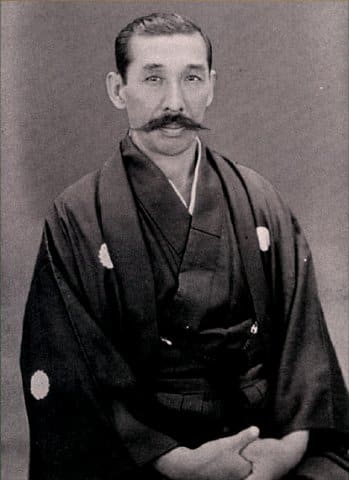
With the Edo period, an era of peace was established in which the warrior lost his principal activity — making war — without losing his rank, and continued to belong to the ruling class. Hayashizaki’s main contribution was therefore more mental and spiritual in nature, since it allowed the samurai to attain and cultivate a psychic attitude that could prove useful in any circumstance. Iai allows the practitioner of any martial discipline to broaden their understanding of bu-do through the study of the sword in all its aspects. This study is organized around four main poles, namely:
- TANDOKU-RENSHU
- SOTAI-RENSHU
- TAMESHIGIRI
- STUDY OF THE JAPANESE SWORD (NOMENCLATURE AND FORGING)
[Tandoku Renshu (individual practice)]{.underline}
This phase of study corresponds to the practice of iai in the strict sense. The practitioner trains alone, without an opponent, with a real sword — or with an unsharpened sword called iaito — by performing kata. A kata is the conventional and formal arrangement of one or more sword techniques that proved effective on the battlefield or that were chosen for their educational value. These sequences reproduce an imaginary combat against one or more opponents and serve as a mental support for the practitioner each time they are performed.
Each iai kata is composed of three or four phases:
-
Nukitsuke, which corresponds to the actual drawing of the blade from the scabbard.
-
Kiritsuke, which corresponds to the cut or successive cuts after the blade has been drawn.
-
Chiburi, which corresponds to the symbolic action of cleaning the blood from the blade.
-
Noto, which corresponds to resheathing the sword.
The reference school is Muso Shinden Ryu, because of the richness of its teaching among all the schools that still exist in Japan today. Its form, its broad curriculum, and its reputation make this school an ideal basic instrument for undertaking the study of other schools and other styles as well. In addition to Muso Shinden Ryu, the Dojo also studies Ryushin Shochi Ryu iaijutsu, thanks to the direct teaching of master Yahagi Kunikazu — Ryushin Shochi Ryu Nidai Soke.
Muso Shinden Ryu consists of a series of 43 kata divided into four levels of practice:
-
Shoden (basic teaching), consisting of a series of 12 kata called “Omori Ryu”.
-
Chuden (advanced teaching), consisting of a series of 10 kata called “Hasegawa Eishin Ryu”.
-
Okuden suwariwaza (deep teaching in kneeling position), consisting of a series of 8 kata called “Oku Iai suwariwaza”.
-
Okuden tachiwaza (deep teaching in standing position), consisting of a series of 13 kata called “Oku Iai tachiwaza”.
Ryushin Shochi Ryu consists of a series of 56 kata divided into 5 levels, 3 levels of practice using the bokken, practice with sharpened blades, and the study of the kodachi (short sword).
The study of iai allows the practitioner to acquire the notions of:
-
Shisei posture
-
Ki-ken-tai coordination between intention, sword, and body
-
Kokyu-ryoku breathing power
-
Zanshin literally “the remaining of the spirit”, or “concentration”
Sotai Renshu (paired practice)
Limiting the study of iai to the mere learning of kata would deprive the practitioner of an understanding, both physical and psychic, of the basic principles that constitute the essence of martial practice in general and of the sword in particular, namely:
-
Ma-ai space/time
-
Kiri-otoshi direct entering cut
-
Ki-ai coordination of energy
-
Koboichi attack and defence at the same time
-
Awase/hazushi, hyoshi rhythm
Sotai Renshu corresponds to the implementation of the techniques and principles studied in Tandoku Renshu. In this phase the iaito is replaced by a bokken — a wooden sword — for obvious safety reasons. For the teaching of this part of the study, this School also refers to the bokken practice of other classical schools, including Jigen Ryu, Yagyu Ryu, Shinto Ryu, and Takenouchi Ryu.
Tameshi Giri (the cutting test)
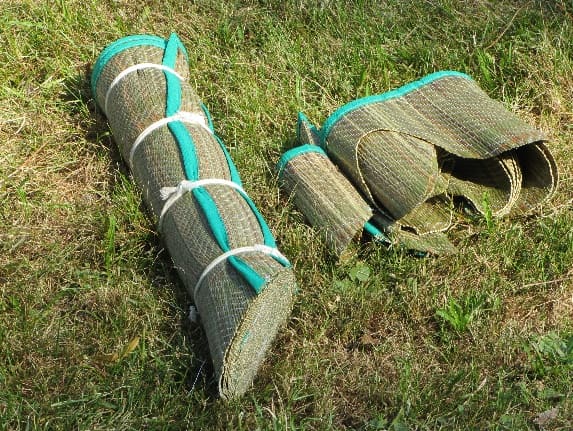 The study of iaido would be meaningless if it did not aim at acquiring the ability to truly cut with a real sword. Historically, the purpose of tameshigiri was above all to test a blade; today it allows the practitioner to verify their technical ability and concentration, as well as the control of their emotions. For this purpose, various targets are used, such as bamboo canes, straw mats, thin suspended ropes, and anything else that does not risk damaging the sword or the surrounding environment.
Nomenclature and forging of the Japanese sword
Like any good craftsman, the practitioner of iaido must know their tool and understand how it is made. They will therefore first commit themselves to memorizing, in Japanese, the names of the different parts of the sword and, subsequently, to improving their knowledge of the manufacturing process and learning to recognize the different techniques used by Japanese smiths throughout history. This specific study is called Nippon-to.
Conclusion
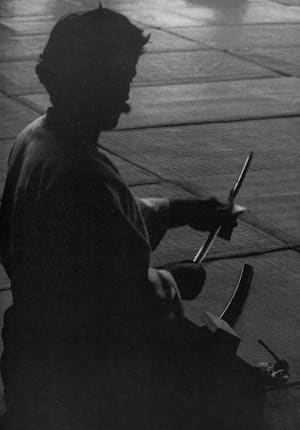 Iai will never be a popular or commercial practice, whatever promotional efforts may be made to introduce it to the general public. Since there is no longer any need to train our body and our technique in order to face, with adequate preparation and training — and therefore with greater chances of survival — an enemy on the battlefield, what use can such exhausting and psychologically discouraging studies and applications have for us in the twenty-first century? What objective should drive us to continue, day after day, such an exhaustive search? The answer is perhaps precisely this: ourselves. The austere, almost ascetic approach of iaido, its introspective character, at times “autistic”, its subjective virtuality — fighting nothingness in the void — and its abstract pragmatism may chill even the most fervent martial arts practitioners. Nevertheless, for more than one reason, particularly at the level of Tandoku Renshu, the practice can be seen as a form of “dynamic meditation” that can help the practitioner of budo — and even those outside it — reconsider the meaning and purpose of their path on the Way, to the point of viewing the Art of the Sword as life itself: where constant practice, day after day, tends toward the impossible and vain search for perfection as an instrument for one’s own development and completion as a human being.
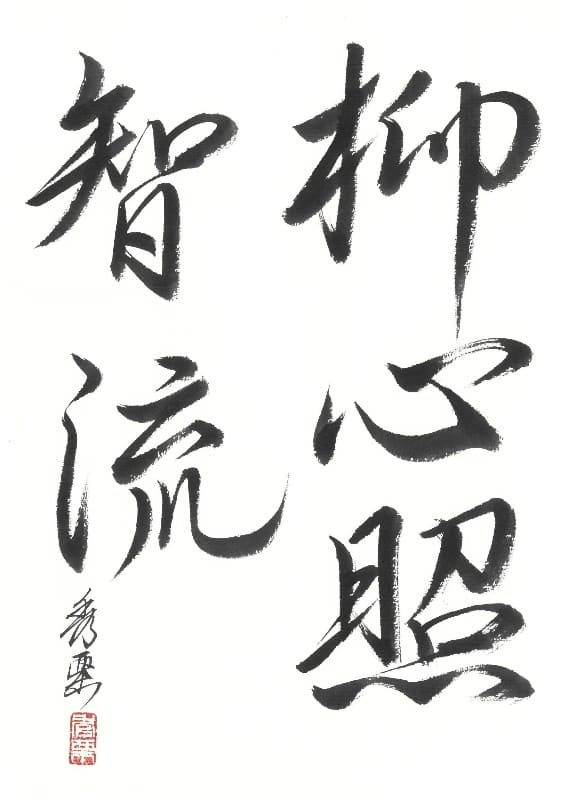
Calligraphy by Pascal Krieger