
AIKIDO AS A COMBAT MARTIAL ART
Historical roots, technical continuity, identity
| Period / tradition | Approximate chronological span |
|---|---|
| Ko Bujutsu or Bugei | c. 900–1600 |
| Ko Budo | c. 1600–1870 |
| Shin Bujutsu | c. 1870–1900 |
| Shin Budo | c. 1900–1945 |
| Gendai Budo | 1945–today |
Introduction — historical periods of Japan
Scholars divide the historical periods of Japan after the establishment of a fixed capital (the Nara period, 710–794) as follows:
- Heian (794–1185), characterized by the predominance of the imperial court
- Kamakura (1185–1333), beginning with military shogunal rule
- Muromachi (1336–1573)
- Azuchi-Momoyama (1573–1603), the age of the three unifiers of the Kingdom of Japan: Oda Nobunaga, Toyotomi Hideyoshi, and Tokugawa Ieyasu. In this period, by military force, they transformed the Japan of the Warring States period (Sengoku period — Sengoku jidai) once again into a unified state. This chapter of Japanese history takes its name from Oda Nobunaga’s Azuchi fortress and Toyotomi Hideyoshi’s Momoyama castle at Fushimi.
Edo (1603–1867), ending with the abolition of the shogunate, the restoration of imperial power (the Meiji period), and the transformation of Japan into an industrial power
Meiji (1868–1912)
Taishō (1912–1926)
Shōwa (1926–1989)
Heisei (1989–2019)
Reiwa (from 2019 onward)
Emperor Seiwa (850–881, reign 858–876), the fifty-sixth sovereign of Japan, is remembered less for the direct exercise of power — strongly conditioned by the regency of the Fujiwara clan — than for his dynastic importance. From his descendants came the powerful Seiwa Genji branch, which would give rise to some of the most influential figures in Japanese military history.
The emperor’s sixth son, Prince Sadazumi Shinnō (873–916), although he held no major political or military role, has crucial historical importance as the genealogical link through which a martial branch of the imperial house developed. His son, Minamoto no Tsunemoto (894–961), received the surname Minamoto (源), thereby founding one of the principal lineages of the clan: the Seiwa Genji.
This genealogical link is fundamental for the history of Japanese martial arts, because Minamoto no Yoritomo, founder of the Kamakura shogunate in 1192, descended from it. The same dynastic branch later produced the Ashikaga and Tokugawa clans, absolute protagonists of the Japanese political and military scene for several centuries.
In many traditional martial schools (koryū bujutsu), the legitimation of the transmission of the “Way of the warrior” (budō) is traced precisely to the Seiwa Genji descent, regarded as a guarantee of continuity between imperial authority and the warrior caste.
In this sense, although Prince Sadazumi was not himself a fighter, his figure assumes a symbolic and genealogical value of primary importance as the point of connection between the imperial house and the warrior dynasties that constituted the historical root of Japanese martial arts.
The problem of image
In recent decades, Aikido has acquired an ambivalent reputation. On the one hand, it is practised by millions of people throughout the world as a system of self-defence and personal development. On the other, in popular imagination and in certain areas of new-age culture, it has progressively been reduced to a meditative practice with vague spiritual content, almost devoid of contact with the reality of physical conflict. There is a version of Aikido that has circulated in Western gyms for decades: an art of peace, of harmony with the universal flow, where fluid movement neutralizes aggression without violence; a discipline for finding oneself, developing presence, and harmonizing with cosmic ki. As a philosophy, it is beautiful. In this distorted reading, O Sensei Morihei Ueshiba becomes an almost mystical figure who supposedly “sublimated” violence into cosmic harmony, and the techniques become gestural symbols rather than instruments for neutralizing an opponent.
Aikido is not meditation in motion. This narrative is not only historically false; it betrays the deep nature of the art. Aikido is the last link in a technical and conceptual chain rooted in medieval Japan, in the combat schools of the bushi, and in the secret transmission of the body arts of the imperial courts.
To understand what it really is, one must retrace that chain from its origin.
False as history
Aikido is the synthesis of a technical combat tradition rooted in seventh- and eighth-century Japan. It is the final product of a thousand-year process of technical selection: practices that worked in combat were transmitted; those that did not work killed those who used them. There is no room for metaphor in this process. There is only applied physics, anatomy, and the psychology of combat.
At the heart of this tradition lies a concept that, over the centuries, underwent a radical semantic transformation: Aiki. Born as the technical description of a precise biomechanical phenomenon — the ability to merge one’s own force structure with that of the opponent in order to neutralize their action — it became, in the hands of Western translators and popularizers, a vague notion of “energetic harmony.” Reconstructing the original meaning of Aiki, period by period, means reconstructing its true history. To truly understand Aikido, one must begin at the beginning: pre-feudal Japan, its wars, its warriors, and the slow accumulation of technical knowledge transmitted in secrecy through generations of practitioners.
From the roots
The roots of the Japanese warrior lie in the Yayoi period (300 BCE–300 CE), when the transition to rice agriculture led to systematic competition for fertile land. The archaeological evidence is unequivocal: skeletons with arrowheads lodged in the bones, settlements protected by ditches and palisades, defensive sites in elevated positions. Organized violence was structural, not episodic.
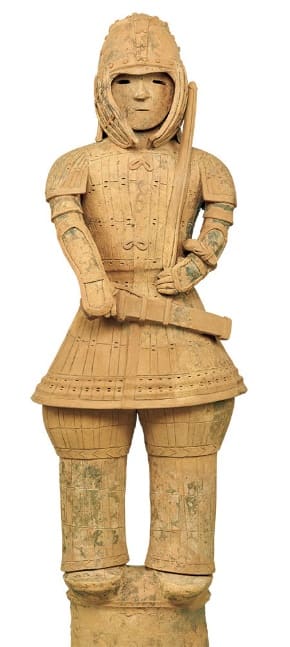 The burial mounds of the Kofun period (300–538 CE) document a society already stratified around military competence. The haniwa, the terracotta figures decorating the mounds, include armed warriors with precise details of armour and weaponry. This was not yet the samurai of popular imagination, but it was his direct precursor: a class whose social position was founded on the capacity for the organized use of force.
With the Nara period (710–794) and the Taika Reform (645), Japan adopted a state system modelled on Tang Chinese bureaucracy, including a provincial army of conscripts, the gundan. The aristocratic families that controlled the provinces, however, developed private guard corps in parallel: hereditary military specialists who transmitted techniques within the clan. It was here that the figure of the bushi was born as a professional of violence, not as a conscript soldier.
Sumai and torite — the first codified forms
The oldest sources documenting specific techniques of hand-to-hand combat date from this period. The Kojiki (712 CE) reports the myth of Takemikazuchi and Takeminakata, two deities who confront each other in a contest of strength involving gripping and twisting the limbs: a mythological narrative that reflects real wrestling practices already systematized. The Nihon Shoki (720 CE) describes sumai matches — the precursor of sumo — organized at court from 642 CE onward.
The sumai of the Nara period was not the ritual sport of contemporary sumo. It was real combat with few restrictions, in which strikes, joint locks, and throws were permitted. The court organized these matches as a selection of the best fighters for imperial service, not as entertainment. The winner demonstrated not only physical strength but technical mastery: the ability to read the opponent’s body and respond with the appropriate technique.
Torite (literally “grasping with the hand”) was the system of control and immobilization used in public-order contexts. Officials charged with arrests used torite to neutralize suspects without necessarily killing them: wrist locks, elbow controls, ground immobilizations. This specific use case — neutralizing without destroying — required greater technical refinement than purely lethal combat and produced a corpus of control techniques that flowed directly into later ju-jutsu traditions and, through them, into Aikido.
The concept of Aiki does not yet exist in this phase as a codified term, but the principle exists: using the mechanical structure of the human body to control an opponent with minimal expenditure of force. It is an empirical principle, derived from the observation of thousands of real encounters.
Transmission in the pre-Heian period — orality and body
In this phase the transmission of combat techniques was entirely oral and bodily. There were no written texts on martial techniques. Knowledge lived in the bodies of practitioners and was transmitted through direct demonstration, physical correction, and repeated practice until automatism. The teacher showed; the disciple replicated; correction occurred through contact: hands adjusting posture, pressures indicating the direction of force. This system of transmission had profound consequences for the nature of the knowledge transmitted. Abstract concepts could not be transmitted; sensations, movement patterns, and automatic responses were transmitted. Technique was not described; it was embodied. This embodiment made knowledge robust against the loss of written texts, but fragile in the face of the death of teachers. A clan that lost its most experienced warriors in battle could lose generations of accumulated technical knowledge.
The response to this problem was the progressive formalization of transmission systems: initiation rituals, oaths of secrecy, and a graded progression of technical revelation. A practitioner did not receive all techniques at once; he received them progressively, as he demonstrated the required maturity and ability.
This system, which would find its most elaborate form in the Ryu of the Muromachi and Edo periods, was already taking shape in the Nara period.
Origins in the Heian period — military context: rules, etiquette, tradition, war, clans, and the birth of kumiuchi
The Heian period (794–1185) is traditionally associated with the apogee of Japanese aristocratic culture and the refinement of the Kyoto court: waka poetry, the novel Genji Monogatari, and the aesthetic refinement of mono no aware. Yet precisely in this period the class of the bushi consolidated: professional warriors who served the great aristocratic families and who, over the following centuries, would conquer political power.
The martial arts of this period were not yet codified into Ryu — schools transmitted through family or disciplinary lines, as would happen in the Muromachi and Sengoku periods — but were rather a set of bodily practices transmitted orally and by imitation within clans, often integrated with knowledge of traditional medicine, functional anatomy, and joint manipulation. Combat in heavy armour (o-yoroi) required specific techniques, and brute force was less effective than the ability to exploit openings and destabilize the opponent’s balance.
Outside the court, in the provinces, the reality of warrior clans in permanent conflict over territorial control was simultaneously emerging, together with the gradual construction of an alternative power system founded on military force. In the eighth century the court abandoned the gundan system, judging it too costly, and filled this void with provincial bushi: specialists in warfare who offered their services in exchange for protection and recognition. The great warrior families — the Minamoto (Genji) in the east and the Taira (Heike) in the west — meanwhile built networks of military alliances extending throughout the country. Their rivalry, which would culminate in the Genpei War (1180–1185), was also the context in which hand-to-hand combat techniques developed and became systematized with greater urgency: warriors who survived carried with them the knowledge of what had worked; those who died demonstrated what had not.
Kumiuchi — technical anatomy of a necessity
Kumiuchi (literally “grappling and fighting”) was the grappling technique used between armed and armoured warriors. It was not an aesthetic choice; it was the compulsory technical solution when the mounted archer was forced to dismount, when distance collapsed and the bow became useless, when combat took place in confined spaces such as fortress corridors or dense woodland.
Heian armour (o-yoroi for mounted warriors, domaru for foot fighters) was built from lacquered lamellae tied together. It protected the frontal zones well but left vulnerable the armpits, the inner joints of the arms, the back of the neck, and the connection points between the different sections. The warrior who managed to embrace the opponent and bring him to the ground could access these vulnerabilities with the tanto, the short dagger that every bushi always carried.
Kumiuchi techniques were therefore designed with precise mechanical objectives: the first was to destabilize the opponent’s posture, breaking his base; the second was to bring him to the ground in a correct position that allowed access to the vulnerable zones and prevented his defence; the third was to immobilize him so that he could not regain mobility.
This three-phase pattern — destabilization, projection or takedown, immobilization — is the fundamental structure of every modern Aikido technique. It is not coincidence; it is thousand-year technical continuity.
The central biomechanical principle was already clear at this stage: a lever on a joint is more efficient than brute force. A warrior who seized the opponent’s wrist and applied controlled torsion in the direction opposite to the natural flexion of the elbow could bring the opponent to the ground regardless of differences in physical strength. Geometry worked regardless of size. This principle — that a smaller practitioner could control a larger one through pure technique — was not only useful but necessary in a world in which warriors fought loaded with heavy armour, which partially equalized physical differences.
The first articulation of the concept of Aiki in Heian sources
Even if the term Aiki does not appear in Heian sources under this name, the underlying concept already exists. Combat chronicles of the period often describe warriors capable of “sensing” the opponent’s intention before it manifests physically, and of responding not to force but to its origin. The Heike Monogatari — the epic of the Genpei War — uses the term waza (technique) to describe this capacity, but describes it as something that transcends simple physical strength: it is the reading of the opponent’s body as a predictable mechanical system.
Minamoto no Yoshitsune (1159–1189) embodies this principle in tradition in its most developed form. The sources describe him as physically small but capable of neutralizing much larger warriors through speed, circular movement, and the use of the opponent’s momentum. His training, whether real or legendary, on Mount Kurama with the warrior monks is described as training that emphasized non-direct opposition to force: entering the opponent’s blind angle, using his inertia, and leading him in the direction in which his structure naturally moves when destabilized. This is Aiki avant la lettre.
Aiki-in-yo-ho — the principle of complementary opposites
In this context the notion of Aiki-in-yo-ho emerges: literally, “the method of harmonious union of the yin and yang principles.” The term is documented in medieval Japanese texts in relation to the arts practised at the imperial court, later adopted by the warrior caste.
In-yo (yin–yang in Chinese) is the system of complementary oppositions borrowed from Chinese cosmology and deeply absorbed into Japanese culture through esoteric Buddhism and Taoism. In the martial context, Aiki does not mean “harmony” in the modern romantic sense, but the ability to unite one’s own force with that of the opponent at the moment of physical contact, in such a way as to neutralize or redirect its vector. It is a biomechanical principle before it is a philosophical one. Whoever comes into contact with a force manifesting against him is able, if he understands the right moment and angle, not to oppose it frontally, but to merge with it and lead it in a direction favourable to himself.
The oldest textual reference explicitly associating the term Aiki with martial arts is found in some documents of the Minamoto family, dating from the end of the Heian period and preserved in later transcriptions.
Scholars such as Donn Draeger, in his fundamental work Classical Budo (1973), and Ratti and Westbrook in Secrets of the Samurai (1973), have analysed how these pre-Ryu principles formed the technical substrate upon which later schools would be built.
Concrete practice in the Heian period — how one trained
The sources do not systematically describe training sessions, but scattered evidence in chronicles and literature allows us to reconstruct a reasonable picture.
Training began in childhood, often between the ages of five and seven, with physical conditioning exercises: running, strength exercises, balance exercises. This was followed by the introduction of light weapons and then, progressively, the standard weapons of the warrior. For hand-to-hand techniques, training took place through fixed forms: predetermined sequences of movements that practitioners first performed alone and then with a cooperative partner. This structure (kata with partner) made it possible to practise techniques too dangerous for free application: for example, a lock could be applied to an elbow in a controlled way, stopping before the moment of breakage, and repeated thousands of times until automatism. Practice with a resisting partner existed but was reserved for more advanced practitioners.
The volume of practice was enormous by modern standards. A young bushi from a good family could devote four or five hours a day to physical training, including horsemanship, archery, sword technique, and hand-to-hand combat. It was not a hobby; it was the profession for which he had been raised. This quantity of practice, accumulated from childhood, produced warriors of technical competence that few modern systems can replicate.
The sohei
A crucial element often overlooked in the history of Heian martial arts is the role of Buddhist monasteries as centres of independent technical development. The sohei — the warrior monks of great monasteries such as Enryakuji on Mount Hiei and Kofukuji in Nara — developed their own combat traditions. Their main specialization was the naginata (the Japanese glaive), but it also included hand-to-hand grappling techniques. Monasteries operated as spaces of technical synthesis: they gathered monks from all over Japan with different martial backgrounds, brought them into contact — a monk from Kyushu brought the techniques of his clan, one from Kanto brought his, and so on — and the resulting systematic comparison and contact generated synthesis and technical development. This monastic cross-fertilization contributed significantly to the diversity and sophistication of hand-to-hand techniques in the Heian period.
Mount Kurama, where tradition places Yoshitsune’s training, was one of these monastic centres. Whether the connection with Yoshitsune is historically accurate or legendary is secondary: Mount Kurama was indeed a place of transmission of specialized combat techniques, and the tradition linking it to the prodigy-warrior reflects a real historical reality, even if the details may have been romanticized.
The medieval and Kamakura period — the codification of combat, the birth of Ryu, and esoteric transmission
With the Kamakura period (1185–1333) and the consolidation of the shogunate’s military power, the martial arts began to be codified into transmissible systems. The first Ryu appeared: combat schools organized around a founder, or a mythical founding figure, and a defined technical corpus, often guarded in secret documents called densho or makimono.
The densho described, often in cryptic form, combat techniques, principles of Ma-Ai, anatomical vulnerabilities, and methods for facing multiple opponents.
The esoteric dimension of transmission must not, however, be confused with new-age spirituality. It was rather a military and social necessity: techniques were the property of clans and families, and their disclosure would have given a tactical advantage to enemies. Secrecy had a practical function, not a mystical one.
Kamakura and Muromachi — war as a technical laboratory, the Kamakura revolution, and the professional samurai
With Minamoto no Yoritomo’s victory in the Genpei War and the founding of the Kamakura shogunate (1185), Japan entered an era of military rule that would last, despite some interruptions, until 1868.
The ruling class was now a warrior class, whose technical culture had resources and institutional legitimacy without precedent. The bushi were no longer mercenaries at the service of the aristocracy: they were the government.
The Kamakura period saw the consolidation of the samurai system as a social class, with its own values and institutions. Zen Buddhism, imported from China during this period, spread rapidly among warriors not because it made them more peaceful, but because its emphasis on mental presence and overcoming the fear of death was functional to effectiveness in combat. Sesshin (intensive meditation retreat) cultivated the ability to maintain concentration under prolonged stress: a martial quality, therefore, not spiritual in the current sense of the term.
A very harsh test for the Japanese martial system came with the Mongol invasions of 1274 and 1281, which produced significant technical adaptations. Mongol warriors did not fight according to the conventions of samurai combat: they did not present themselves in individual duel, but used mass-formation tactics and long-range bows. The Japanese had to adapt rapidly, developing tactics that could work against opponents who were numerically superior and technically different. This forced adaptation also accelerated the development of close-combat techniques.
Aiki-jutsu and the Minamoto family
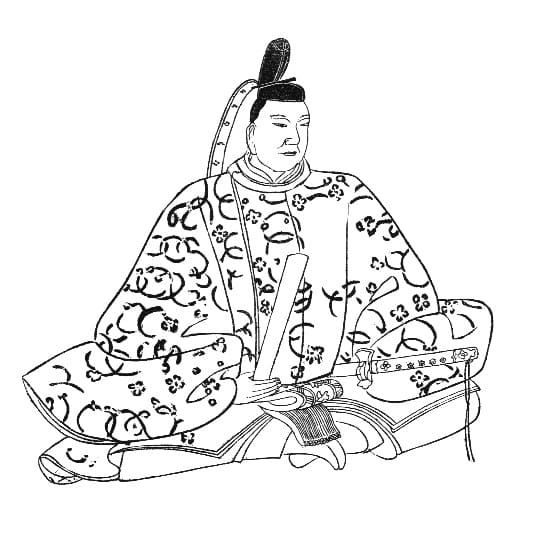 The tradition leading most directly to modern Aikido is linked, in the genealogies transmitted by the Daito-Ryu school, to Minamoto no Yoshimitsu (1056–1127), also known by the honorific name Shinra Saburō, a samurai belonging to the powerful Minamoto clan. Yoshimitsu is said to have systematized hand-to-hand combat techniques by observing the anatomy of corpses, a practice documented in other Asian warrior traditions as well, especially the functioning of joints, in order to perfect joint-locking and control techniques (kansetsu-waza). In doing so he developed a systematic understanding of human joints and of the body’s vulnerable points, which became one of the distinctive components of his teaching. This knowledge was then transmitted to his son Yoshikiyo.
This technical corpus, called Aiki-jutsu or, in some variants, the “internal” ju-jutsu arts, is said to have been transmitted within the family through the generations of the Minamoto and, later, the Takeda in the domain of Aizu.
The Minamoto clan was one of the most influential houses in Japan, and thanks to this, in 1051 Yoriyoshi — head of the family and daimyō of the province of Chinjufu — was commissioned by the emperor to suppress a revolt led by the Abe clan. The conflict, known as the Zenkunen War, lasted eleven years (1051–1062) and ended with the defeat of Abe Sadatō at the battle of Yakata Koromogawa. Later, Yoriyoshi’s sons — Yoshiie and Yoshimitsu — took part in the Gosannen War (1083–1087) against the Kiyohara clan.
Yoshimitsu was lord of Daitō Castle, from which the school would later take its name. At the end of the conflict his son Yoshikiyo moved to Kai Province, near the locality of Takeda, assuming the name Takeda Yoshikiyo. From him arose the new family branch known as the Kai Genji Takeda, whose founder received from the shōgun the hereditary title of daimyō, with all the associated feudal rights and privileges.
The first secure documentary attestations, also independent from the clan, date from this period, and specifically from the year 1087. From this historical basis developed Daitō-ryū, a school that for centuries preserved and perfected Aiki-in-yo-ho. Already in 1087 the Takeda clan taught a wide range of martial disciplines, including archery, horsemanship, spear, glaive, sword, military strategy (including waterworks, excavations, and fortifications), and hand-to-hand combat.
Although the circumstances surrounding the origins of Daitō-ryū Aikijūjutsu prior to 1087 cannot be documented with certainty, and although the events and genealogical narratives attributed to the clan find little verifiable confirmation before that date, from 1087 onward both oral and written sources contribute significantly to the historical reconstruction of the school and of the Takeda clan. Part of these testimonies were transmitted through the Takeda family itself, especially by Takeda Tokimune, the last sōke of the school.
It is necessary to state that these genealogies, like almost all genealogies of medieval Ryu, contain legendary elements that cannot be fully verified by modern historical methodology. Nevertheless, as Ellis Amdur — an advanced practitioner with training in several traditional Japanese schools — observes in Hidden in Plain Sight (an indispensable reference for the study of Japanese internal martial arts, 2009), the presence of consistent and verifiable techniques over centuries of transmission suggests, beyond the mythological elaborations of origins, a real technical continuity.
The Sengoku period — the Darwinian selection of techniques
The Sengoku Jidai — the Age of Warring States (1467–1615) — was the period of greatest technical development in the history of Japanese martial arts. A century and a half of almost continuous war meant immediate and brutal feedback on every technique: those that worked in real combat were transmitted; those that did not killed those who used them. There was no room for ineffectiveness. Selection was Darwinian in the most literal sense.
It was in this context of technical urgency that the great Ryu were formed: formal schools with codified curricula. Takenouchi-Ryu (founded in 1532) is the oldest recognized ju-jutsu Ryu, but it was one among many: Shosho-Ryu, Tenshin Shinyo-Ryu, Kito-Ryu, and Sekiguchi-Ryu developed in the following decades. Although each emphasized different specializations, all shared a fundamental orientation: every technique had to have been tested in real combat by someone, at some point in the history of the Ryu. The curricula of these Ryu included atemi techniques (strikes to vital points), joint locks, throws, strangulations, ground fighting, and often armed-combat techniques.
They were not aesthetic systems. They were technical repertoires selected for applicability in real combat against armed opponents fully intending to kill.
Secret transmission in the Ryu — the system of technical initiation
The system of technical transmission in the Ryu of the Muromachi and Sengoku periods reached extraordinary sophistication. Knowledge was stratified into levels of progressive initiation, each accessible only after the demonstration of mastery of the previous level. The names of the licences varied according to the schools — shoden, chuden, and okuden were common terms — but the principle was universal: the most effective and most dangerous techniques were reserved for the most advanced practitioners.
This was not merely institutional conservatism. There was a precise technical logic: the most advanced techniques, those that exploited leverage and Aiki principles most fully, were often counterintuitive. A body trained in natural strength responses would execute these techniques clumsily, even with the best intentions. It was therefore necessary first to build a solid technical base, then deconstruct natural responses, and finally rebuild on a new foundation. Graded progression served precisely this pedagogical purpose.
As already noted, the technical manuscripts, the densho, were written in deliberately obscure language, understandable only to those who had already received the oral teaching. They were not instruction manuals, but memory supports for those who already had the knowledge embodied in the body. This choice was not mere obscurantism. It also prevented someone who had obtained the text illegitimately from replicating the techniques without the necessary training. The safety of the most dangerous and secret techniques depended on the fact that those applying them had the mastery needed to do so without damaging their training partners too much.
The concept of Aiki in Muromachi texts — first formalization
The term Aiki appears for the first time in written documents of this period, in the densho of the most advanced Ryu. Its original technical meaning is precise: the ability to “unite” one’s own force structure with that of the opponent so as to neutralize the opponent’s action before it fully manifests.
It is not a mystical operation. It is a description of what happens biomechanically when an expert practitioner responds to an attack not with opposing force, but with a structure that integrates with, and then redirects, that of the attacker. The distinction between Aiki and simple ju (yielding, softness) was already clear at this stage: ju described the tactic of not directly opposing the opponent’s force, yielding in order to redirect it, whereas Aiki described something subtler: the ability to perceive the opponent’s force structure at the moment of its formation, even before the physical attack manifests, and to respond in a way that renders it ineffective at its source, not merely during its development. It was the difference between redirecting a river already in motion by opening an alternate outlet and acting before the water begins to move.
Aiki in the Muromachi densho: “the union of force structures.” It is not therefore a specific technique, but a principle that permeates all the techniques of a practitioner who has reached a certain level of mastery. The practitioner who has Aiki does not perform techniques differently; he performs them from the same point from which they arise.
Oshikiuchi — the secret art of the imperial court — transmission
An often neglected aspect in the history of the arts leading to Aikido is the line called Oshikiuchi: literally “inside techniques” or, according to some interpretations, “techniques practised inside the palace.”
This system is associated with the imperial court of Kyoto and, according to the tradition transmitted by Sokaku Takeda and then by Morihei Ueshiba, would constitute one of the oldest layers of technique that flowed into Daito-Ryu.
Oshikiuchi has long been the subject of debate among scholars of Japanese martial arts. Its peculiarity would have been that of being a combat system adapted to the restricted spaces of palace architecture and to the behavioural conventions of the court, where one could not freely draw weapons or use wide-ranging techniques.
This produced a highly sophisticated system for controlling the opponent’s body through locks, pressures, and torsions, executable even in kneeling position (seiza) or at very close distance.
Ellis Amdur devotes detailed analysis to the question of Oshikiuchi, concluding that, although it is difficult to separate history from transmission mythology, the existence of internal combat techniques distinct from those of the battlefield is historically plausible in the context of the Japanese aristocratic courts of the Heian and Kamakura periods. Similar techniques are also documented in some schools of kenjutsu and jojutsu.
The element of zero distance
What technically distinguishes Oshikiuchi from many other combat systems is its emphasis on zero distance: the ability to neutralize an opponent at the very moment of contact, before the aggressive movement has completed its development. This principle, which in modern terms could be described as “interruption of the kinetic chain,” required, as already described, extraordinary tactile sensitivity and a deep understanding of the biomechanics of the aggressive gesture. It is precisely this principle that lies at the technical heart of Daito-Ryu first and Aikido later: the ability to neutralize an attack not by opposing force but by intercepting its intention at the initial moment.
What is mistakenly interpreted as “spiritual non-resistance” is in reality a precise biomechanical technique that requires years of specific training to develop.
Daito-Ryu Aiki-jujutsu — the system of Sokaku Takeda
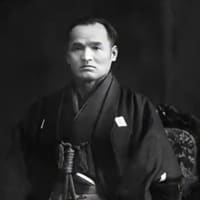 The figure of Sokaku Takeda (1859–1943) is fundamental for understanding the martial nature of what would later become Aikido. Takeda was an extraordinarily violent man, even by the standards of his time. He was not a philosopher of cosmic harmony. His biographical records, documented in the student register (eimeiroku) and studied by Stanley Pranin (1949–2015, founder and editor of Aiki News, later Aikido Journal), describe an individual who fought in real duels and survived numerous physical confrontations in Meiji-transition Japan. Pranin, in Daito-Ryu Aiki-jujutsu: Conversations with Daito-Ryu Masters (1994), collects direct testimonies from Takeda’s senior students, who describe his teaching as intensely physical and pragmatic. There was no room for philosophical vagueness. Techniques had to work against resisting opponents, and Takeda often demonstrated them with a harshness that left deep marks on practitioners’ bodies.
The curriculum of Daito-Ryu
Daito-Ryu Aiki-jujutsu is the technical system from which Aikido descends most directly.
It is a complete martial system comprising hundreds of techniques organized in kata (codified forms) of progressive complexity. Its official history, as noted above, claims descent from the Heian period through the Minamoto family first and the Aizu family later. The historical evidence for this genealogical continuity is incomplete. What is historically documented is that Sokaku Takeda, probably synthesizing several regional traditions to which he had access thanks to his position in late nineteenth-century samurai society, systematized and transmitted a technical corpus of exceptional richness.
The Daito-Ryu curriculum was organized into graded technical series: goshin-ho (basic self-defence techniques), then the series from ikkajo to gokajo (first to fifth level), and then the more advanced Aiki no jutsu techniques reserved for higher-level practitioners. This structure reflected the secret-transmission system of traditional Ryu: basic techniques were accessible to many, advanced ones to few, and the deepest only to practitioners who had demonstrated the necessary maturity.
Crucial in Daito-Ryu is the distinction between jujutsu and Aiki-jujutsu: jujutsu is based mainly on mechanical principles of leverage and torsion applied with force; Aiki-jujutsu adds the dimension of the “invisible touch,” the ability to destabilize the opponent’s balance before the physical technique fully manifests. This capacity — called Aiki — is not supernatural. It is the result of a refined understanding of bodily tensegrity, the centre of gravity, and the neuromuscular structure of reflex response.
The concept of Aiki in Daito-Ryu had a precise technical meaning that Sokaku Takeda did not explain verbally. He demonstrated it physically, letting the disciple experience the sensation of being controlled by a force that did not seem to come from muscular strength. This pedagogical approach — transmitting through sensation rather than explanation — was consistent with the centuries-old tradition of bodily transmission in Japanese martial arts. A verbal explanation of the phenomenon was considered necessarily inadequate, because Aiki is understood in one’s own body, not when it is heard described.
Daito-Ryu was taught by Takeda to samurai, police officers, military personnel, and naval officers. The register (eimeiroku) documents thousands of students, including officers of the imperial army, police agents, and bodyguards. This fact alone refutes the idea that it was a purely ceremonial or spiritual art: no army and no police force in the world invests resources in training techniques that do not work.
The Japanese researcher Tokimune Takeda, Sokaku’s son, confirmed in numerous interviews published in Aiki News that Daito-Ryu techniques were conceived for real combat situations, including defence against armed opponents. The educational and personal-development dimension was certainly present, as in all the great Japanese martial traditions, but it was subordinate to, not a substitute for, technical effectiveness.
The Edo period — peace, Dojo, and the philosophy of combat: the paradox of the warrior without war
The Pax Tokugawa — almost two and a half centuries of internal peace after the battle of Sekigahara in 1600 — created an unprecedented existential paradox for the samurai class: they were professionals of war in a country that no longer made war. The martial arts therefore had to reinvent themselves. The response was twofold: on the one hand the proliferation of Dojo and the formalization of schools with codified curricula, and on the other the philosophical elaboration of the meaning of martial practice in the absence of war.
With the Tokugawa peace, the Sengoku era ended: a period characterized by total anarchy, with dozens of daimyō (feudal lords) fighting one another. Central power now found itself in the delicate situation of having to manage a multitude of fighters — of considerable violence — who had spent their entire lives training and perfecting the use of weapons and who now found themselves unemployed, even if many were recycled into public administration as bureaucrats, administrators, tax collectors, and so on, and without the possibility of “venting” their bellicosity and restlessness.
At this point politics asked religion — in this case Confucianism — for help in providing the samurai with a system of “civilization”: on the one hand preparing military personnel to administer the country’s civil affairs in peacetime; on the other, in a strictly Confucian sense, inducing professional warriors to internalize a control structure involving subordination to the public interest. In this way social order was guaranteed, and perpetual, violent, and uncontrollable struggles of force and power were eliminated.
More than a religion, Confucianism is above all a moral system tending toward practical good and considering good and evil only as a matter of correct or incorrect behaviour in view of maintaining social order.
During this period, also as a result of the influence of Zen on bujutsu, the idea spread that the soul of the samurai resided in the sword he carried, transforming it from an instrument of death into a support for his own perfection and meditation. The samurai then had to strive for self-perfection through continuous self-searching, identify the true enemy in himself and in the illusions of the ego that had to be relentlessly destroyed, and so on.
Types of weaponry also changed: the disappearance of armour, since combat now became more urban than military-field combat, led to the development and increased importance of unarmed combat styles (Hadaka Waza [hadaka = naked, without armour]).
The structure of the Dojo became formalized as a space dedicated to practice, with a clear hierarchy of master and disciples, rituals of entry and exit, and a precise code of conduct. Practice was organized around kata — fixed forms — and progressively enriched by semi-free and free forms of practice aimed at developing the ability to apply techniques under variable conditions. The volume of practice remained very high for samurai of rank: four or five hours of daily training was not unusual for those who had the time and resources. But the social structure of the Edo period had now changed the demographic composition of practitioners: no longer only high-caste bushi, but also wealthy merchants, artisans, and anyone who could afford to pay the Dojo fees.
This broadening of the practitioner base brought greater economic resources to the Ryu, but also the need to adapt pedagogy to people who had not begun training in childhood. The response was the gradual standardization of teaching methods and the creation of more accessible kata capable of transmitting fundamental principles even to adult practitioners.
This process of “technical democratization” is the direct ancestor of the modern pedagogies of judo, kendo, and Aikido: systems designed to transmit a deep technical tradition to people who have not devoted their entire childhood to training.
We now report two examples, different in approach but linked by their purpose.
Zen Buddhism and martial thought — an analysis of the psychological technology of combat
The relationship between Buddhism, especially Zen, and Japanese martial arts is one of the greatest misunderstandings in Japanese cultural history.
The popular version, spread in the West through texts such as Zen in the Art of Archery (Eugen Herrigel, 1948), presents Zen as a way to transcend technique through spirituality.
This interpretation is the product of a Western projection — the search for spiritual alternatives to modernity — more than an accurate understanding of Japanese tradition.
Zen was adopted by Japanese warriors for pragmatic reasons: its meditation practices produced measurable benefits in martial training. The ability to remain calm under stress, to act without hesitation, and to perceive the environment clearly even under conditions of danger are qualities cultivated through regular meditation, and they are strictly martial qualities, not spiritual ones in the sense so beloved of the new age. Zen masters did not teach samurai how to be spiritual; they taught them how to be more effective in combat through mastery of mental states.
Herrigel’s mistake, and that of those who followed him, was to take Buddhist vocabulary used to describe mental states functional to combat and reinterpret it as a description of spiritual states for their own sake. Mushin (“empty mind”) is not a state of spiritual bliss; it is a state of optimal attention, free from the interference of analytical thought, in which accumulated technique can express itself without obstruction. It is functional, not transcendent.
The Zen monk Takuan Soho (1573–1645), in his correspondence with the sword master Yagyu Munenori, articulated the relationship between mental states and martial performance with a precision that has no equivalent in contemporary literature. His Fudochi Shinmyoroku is often cited as an example of the spiritualizing influence of Zen on martial arts. A close reading, however, reveals something quite different: it is a technical-pedagogical text that uses Buddhist vocabulary to describe psychological phenomena with precise martial implications.
Takuan’s central concept is the “mind that does not stop”: a state in which the mind does not fix itself on any particular point of the environment or the opponent, maintaining open and diffuse awareness. When the mind fixes on a specific threat, on a technique one intends to execute, on panic, and so on, it slows the response and makes it predictable. When the mind is free and mobile, the response emerges from accumulated technique without the interference of conscious thought.
This is what contemporary cognitive psychologists call “flow” — or a state of optimal performance — and Takuan described it four centuries in advance. What Takuan described was not a spirituality alternative to technique, but a psychology that allowed technique to express itself with maximum efficiency. A practitioner without technique could not benefit from Takuan’s mushin, because he had nothing to express.
Takuan’s text was addressed to Yagyu Munenori, already a kenjutsu master of absolute excellence. Their correspondence was a dialogue between experts on how to bring already-acquired competence to its highest level of expression; it was not an invitation to replace technique with meditation.
Miyamoto Musashi and technical philosophy
Miyamoto Musashi (1584–1645), the most famous representative of Japanese kenjutsu, with more than sixty documented duels won, articulated in the Gorin no Sho (The Book of Five Rings, 1645) a philosophy of combat of extraordinary technical precision.
He was not a mystic; he was an empirical warrior describing what worked.
Musashi’s principles relevant to the genealogy of Aikido include: the importance of rhythm and Ma-Ai as factors that matter more than brute force; the need to adapt to the opponent rather than follow fixed patterns; the ability to perceive the whole situation rather than focus on details; and the principle that victory is achieved first in the mind, then in the body. These principles are not mystical concepts, but empirical observations by a man who had tested his ideas in real combat dozens of times.
The link between Musashi and Aiki is not direct — Musashi had no disciples who in any way descend to Ueshiba — but conceptual: both articulate the same understanding of combat as a system in which perception and structure count more than strength.
This convergence is not coincidence. It is the endpoint of a coherent technical tradition.
The Meiji Restoration — trauma and the reinvention of Budo
The Meiji Restoration of 1868 was another trauma for Japanese martial arts.
The feudal system was dismantled, the samurai class abolished as a legal entity, and swords were prohibited in public. The result was that the martial arts lost their immediate social function.
The response was their reinvention as tools of national education and cultural identity. Jigoro Kano’s judo (1882) was the most brilliant case: Kano understood that to survive, Budo had to enter the modern school system, adopt rationalized pedagogical methods, and eliminate techniques too dangerous for systematic practice. Kano kept randori (free combat) as the heart of the method, thus preserving — even if regulated — the dimension of combat. This was the key to judo’s success.
Together with judo, kendo developed in parallel as a sporting version of traditional kenjutsu. Both systems, while adapting their form to the requirements of modern Japan, maintained their martial substance. The Dai Nippon Butokukai, founded in 1895, institutionalized this process of adaptation.
It was in this context that the concept of budo (“martial way”) took shape in contrast with earlier bujutsu (“martial art”). The distinction is not purely terminological; it reflects a real change in the orientation of practice. Bujutsu was explicitly oriented toward effectiveness in real combat, whereas budo incorporated a formative dimension that transcended immediate warlike application.
Importance and differences in the main characteristics of martial development
BuJutsu:
1 - Use of combat techniques on the battlefield
2 - Knowledge and use of weapons
3 - Knowledge and use of armour
From these characteristics one may infer the three levels of requirement demanded by central power:
1a - Effectiveness in combat
2a - Moral and social code of behaviour (to control 1, 2, 3, and 1a)
3a - Spiritual search (many schools were connected to a temple, Buddhist or Shingon, or were linked to a family line of succession: iemoto)
Tokugawa peace:
1 - moral code (now becoming the first element and characteristic of a fighter)
2 - effectiveness of techniques
3 - spiritual search
Shin Budo:
1 - spiritual search
2 - moral and social code of behaviour
3 - combat effectiveness and the introduction of competition (shiai)
Realizing that martial culture was being lost to modern culture, an elite of enlightened visionaries gave birth to a cultural movement through which a more modern martial system in the educational sphere was codified (for example Aikido, Judo, Karate, and so on). BUT, and this is the point systematically obscured by the new-age drift, this formative dimension still presupposed technical competence.
There was no Way without Art; there was no budo without bujutsu.
Morihei Ueshiba: the formation of a master and the birth of Aikido
Morihei Ueshiba (1883–1969) grew up in this Japan of transition.
His martial formation was broad and systematic: he studied Goto-ha Yagyu Shingan-Ryu ju-jutsu, kenjutsu, jojutsu, and then came the decisive encounter: Daito-Ryu Aiki-jujutsu with Sokaku Takeda.
He studied under Takeda with an intensity that the master himself recognized as exceptional. Takeda’s student register, preserved and published by Stanley Pranin, documents that Ueshiba received menkyo kaiden (certification of full transmission of the system).
Stanley Pranin documented this phase of Ueshiba’s life in detail, showing how the technical corpus of early Aikido was substantially identical to that of advanced Daito-Ryu.
Ueshiba was not an occasional practitioner. He was a master of Daito-Ryu in the full sense before developing Aikido, and this point is fundamental.
Aikido did not arise from a spiritual visionary who added a few martial techniques to his religious practice. It arose from a technically excellent warrior who found in Omotokyo a structure for philosophically interpreting what he had already achieved physically: first technique, then reflection on technique.
The years between 1915 and 1942 were years of extremely intense training and continuous technical development. Ueshiba taught and learned simultaneously, and contact with high-level students forced him continually to refine his understanding of technique. During this period Aiki-Budo, as the system was called before the name Aikido, spread in military and imperial navy circles. Military institutions never adopt combat systems for spiritual reasons: Aiki-Budo was considered useful because it worked.
The concept of Aiki in Ueshiba — the personal interpretation
Morihei Ueshiba was a fervent follower of the Omotokyo sect, a syncretic religious movement founded by Nao Deguchi at the end of the nineteenth century.
His conversion was real and profound, and the spiritual dimension of his practice was authentic. But to understand this spirituality correctly one must situate it within the Japanese martial tradition, not within Western new-age spirituality.
Ueshiba’s authentic spirituality was that of the great masters of the Japanese martial tradition: the conviction that technical mastery, carried to its limit, produced a transformation of the practitioner with dimensions transcending the purely physical.
This transformation, however, was always the result of technique, never its substitute. The disciples who tried to separate the two dimensions — keeping the spiritual part and lightening the technical part — obtained something the master would not have recognized as his own.
Ueshiba articulated the concept of Aiki in a distinctive way, using a vocabulary that mixed traditional technical terminology with the religious language of Omotokyo. For him, Aiki was not only a technical principle, but the physical manifestation of a cosmic principle of harmony. The union of force structures in combat reflected the union of the individual with the flow of the universe.
After his religious conversion, Ueshiba trained with increasing intensity, because technical perfection was for him a spiritual necessity. A technically approximate Aikido was not, in his vision, a spiritualized Aikido; it was simply wrong Aikido.
This interpretation was sincere and coherent with his worldview, but it created a problem of transmission. Disciples who did not share Ueshiba’s religious vision, the majority, received the mystical vocabulary without the technical understanding that formed its foundation. They spoke of Aiki as cosmic harmony without understanding the biomechanical phenomenon that Ueshiba called by that name. The most brilliant disciples resolved this problem in different ways: some emphasized technical precision while bracketing the philosophical dimension; some documented the complete curriculum with almost academic rigour; others developed a teaching system of Ki as a verifiable physical phenomenon. His son Kisshomaru, for example, chose the path of spiritual simplification for reasons of accessibility and dissemination. Each preserved something; each lost something.
The post-war context — pacifism and reinvention: how Aikido lost itself
The defeat of 1945 and the new pacifist constitution radically transformed the Japanese cultural context.
The American occupation forces temporarily prohibited the practice of martial arts as instruments of defeated militarism. When the prohibitions were lifted, Japan had become a country that had constitutionally renounced war. The martial arts therefore had to reinvent themselves once again.
Kisshomaru Ueshiba, who gradually took over leadership of the Aikikai Foundation while his father withdrew to the countryside of Iwama, chose a precise direction: Aikido as an art of peace, non-violence, and harmony. It was an understandable choice in the historical context: post-war Japan no longer had cultural space to accept a martial art that explicitly presented itself as a combat system. This, however, would have a technical cost that would become apparent in later generations. The curriculum that Kisshomaru disseminated was technically simplified compared to that practised by his father: atemi (strikes to vital points, which Ueshiba had described as an integral and predominant part of Aikido practice) became symbolic gestures; the partner’s resistance in exercises was reduced in order to preserve the aesthetic fluidity of movement; and the combat context that made the techniques intelligible was progressively removed from pedagogical explanation.
Western publishing and the construction of the new-age myth
The spread of Aikido in the West took place in the 1960s and 1970s, in a cultural context particularly receptive to the esoteric dimension of Eastern disciplines.
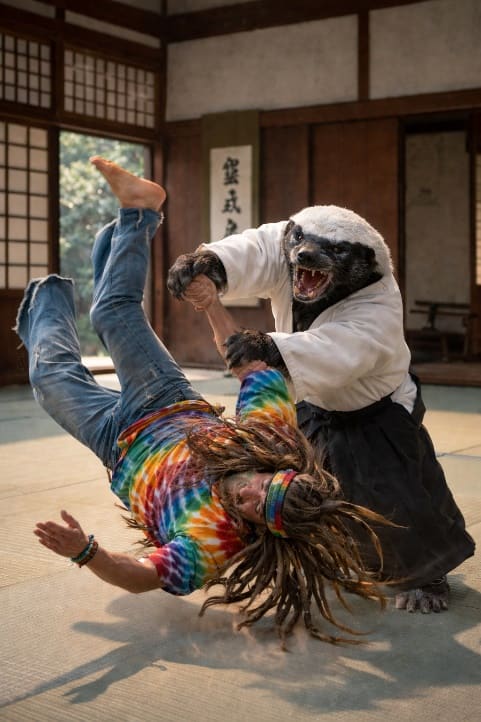 America and Europe were discovering yoga, meditation, and tai chi. In this cultural market, Aikido, with its vocabulary of Ki, Aiki, harmony, and its apparently fluid and non-aggressive techniques, fit perfectly. This led to a selection of the art’s elements that privileged the philosophical components at the expense of the technical ones.
Several causes contributed to this drift. One was certainly Ueshiba’s choice, in the final years of his life, to emphasize spiritual and cosmological language in his public explanations, leaving concrete technical explanations to his senior teachers. His speeches, partially translated into various languages, are indeed dense with cosmological references that remain obscure without training in Shinto and Japanese esoteric thought.
Some publishers produced texts on Aikido that stressed almost exclusively its mystical dimension, and translations of technical vocabulary were often revealingly imprecise: Ki became “cosmic life energy” instead of something closer to “structured force” or “organized kinetic energy”; Aiki became “harmony with the universe” instead of “fusion of force structures.” These shifts of meaning, multiplied over thousands of pages and decades of publications, had the consequence of constructing an image of Aikido almost unrecognizable from its origins.
Kisshomaru Ueshiba’s book The Spirit of Aikido (Kodansha International, 1984) contributed decisively to this narrative. The intention was legitimate: to make Aikido accessible and present it as a universally applicable system of personal development. The result was that the most widely circulated text on Aikido in the West presented the art as a semi-esoteric philosophy with the addition of some physical applications, rather than as a combat system with a profound formative dimension. The inversion of the relationship between technique and philosophy was thus complete.
The most rigorous response to this drift came from the already mentioned Stanley Pranin, who published hundreds of interviews with first-generation practitioners, archival documents, and technical analyses that redrew the official history. Together with some senior teachers, he also highlighted a progressive reduction in training intensity in many schools, a phenomenon documented and openly discussed precisely in Aikido Journal: “without training that includes real resistance from uke, the techniques tend to become increasingly choreographic, and the martial dimension empties itself of content.”
Given that Sokaku Takeda’s technical influence on Ueshiba was far greater than many wished to admit, that Daito-Ryu and Aikido techniques were practically identical in the first generations, and that many developments presented as the founder’s spiritual innovations were adaptations of existing Daito-Ryu techniques, Pranin’s discoveries consequently became systematically uncomfortable for the Aikikai establishment. He insisted, in fact, that Ueshiba’s spiritual dimension was inseparable from his technical competence, but not an alternative to it.
Pranin paid for these discoveries with ostracism from part of the Aikikai establishment, but his work remains the most reliable historical source on Aikido. The Aikido Journal archives, now available online, are an indispensable resource for anyone who wants to understand the art without ideological filters.
Ellis Amdur also offered a rigorous analysis of the extraordinary abilities attributed to great masters. His thesis is that those abilities were not mystical, but the result of specific body training called internal power, which developed deep neuromuscular coordination through practices transmitted in obscure but not supernatural ways. Amdur’s internal power is a physiological description of what Japanese practitioners called ki or Aiki: the ability to generate and transmit force through the body in non-conventional ways by exploiting the tensegrity of the musculoskeletal structure and the coordination of large muscle groups.
It is not magic. It is physiology applied to combat, transmitted through specific practices that the Ryu guarded jealously. Amdur’s thesis is important because it allows one to recover the substance of the claims made by classical masters without having to embrace metaphysical explanations. Aiki exists as a real physical phenomenon: the subjective sensation of highly developed bodily coordination manifesting as the ability to control an opponent with apparently minimal force. It can be studied and trained, it can be applied in combat, and it does not require belief in cosmic energy.
Examining some of the fundamental techniques of Aikido is enough to understand their martial nature.
Ikkyo, the first technique of the curriculum (corresponding to ikkajo in Daito-Ryu), is a lock on the elbow and shoulder which, when carried into its applied form, produces immediate immobilization or joint damage. It is not a symbolic technique; it is a physical control that works for precise anatomical reasons, exploiting the rotational direction of the shoulder joint and the hyperextension of the elbow.
Irimi nage is a technique that requires entering on the opponent’s line of attack, taking control of the opponent’s structure through contact with the nape and shoulder, and then projecting the opponent to the ground through an imbalance generated by altering the vertical axis. It is a technique that exploits principles of physics applied to the human body, not cosmological metaphors.
The principle of Aiki, in its technical meaning, is advanced mechanics and biomechanics: fascial tension, organization of the centre of gravity, and optimized use of the skeletal structure rather than isolated muscular strength. Aiki is not a mystical energy but a set of advanced bodily competences, trainable, calculable, and measurable.
The current sōke of Daito-Ryu, Katsuyuki Kondo, guardian of the classical transmission, has repeatedly stated in interviews with Aikido Journal that Aiki is a concrete technical skill requiring a specific training method to be developed, and that its loss in modern Aikido schools is due precisely to the abandonment of that training method.
The problem of cooperation in training
The question of cooperation in training is complex and is not solved simply by introducing randori.
The classical Japanese tradition, of which Aikido is an integral part, has always valued kata as a method for the precise transmission of technique. It allows one to learn highly complex movements that randori does not permit, since in randori one adapts to the limitations of technique instead of bringing it to its ideal form.
The problem is not kata in itself, but the loss of understanding of its martial purpose. A kata practised with awareness of its real applications, with an uke offering progressive and coherent resistance and understanding the physical consequences of the technique, is a very powerful training tool.
A kata practised as a harmonious dance is, precisely, only a harmonious dance.
Recovering historical truth
Aikido is therefore the product of a thousand-year technical chain that passes through the Heian period, the medieval codification of bushi combat, the transmission of palace arts, Sokaku Takeda’s systematization, and Morihei Ueshiba’s brilliant synthesis.
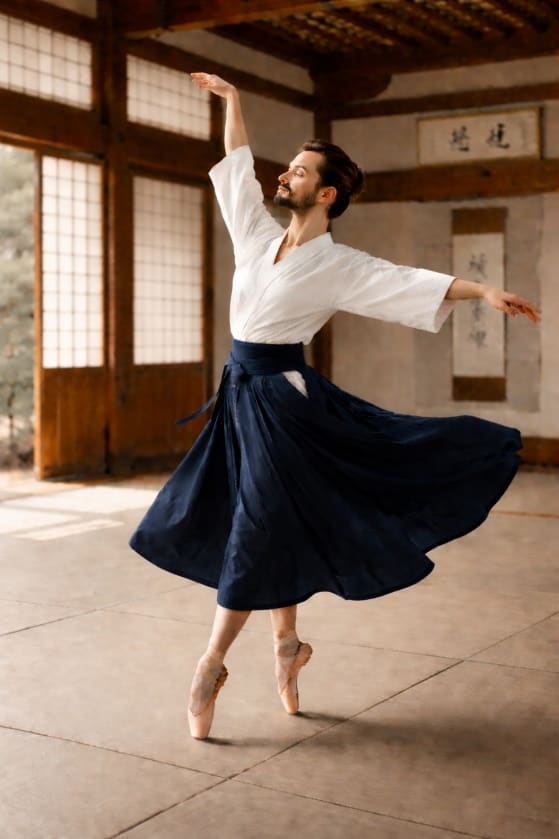
In every link of this chain, martial effectiveness was the ultimate criterion of validity. The philosophical, aesthetic, and spiritual dimensions were present, as in all great Asian martial traditions, but they were superstructures of a concrete technical practice, not alternatives to it.
To state that Aikido is a spiritual art emptied of martial content is a historically unfounded claim that betrays both the tradition and the practitioners. Paradoxically, it also impoverishes the spiritual dimension itself, because a spirituality that has no roots in real bodily practice risks becoming cosmological sentimentalism.
According to numerous testimonies, O Sensei said that “Budo is love.”
But according to Gozo Shioda’s testimony, he also added: “If you cannot throw your opponent, do not speak to me of love.”
The evolution of the concept of Aiki — a summary through the periods
Retracing the evolution of the concept of Aiki through the ages makes it possible to see clearly how a precise technical notion was progressively spiritualized until it lost its original content.
In the Heian and Kamakura periods, Aiki does not yet exist as a codified term, but the principle is operative: reading the opponent’s body as a predictable mechanical system, responding to the structure of force rather than to its physical manifestation. It is an empirical principle, derived from the observation of thousands of real encounters and transmitted through bodily practice before being linguistically conceptualized.
In the Muromachi and Sengoku periods, the term Aiki appears in the densho of the most advanced Ryu, with a precise technical meaning: the ability to unite one’s own force structure with that of the opponent in order to neutralize the opponent’s action at its source. It is a technical concept reserved for the most advanced levels of transmission, surrounded by secrecy because it represents the most sophisticated core of the system.
In the Edo period, the concept acquires an explicit psychological dimension: Aiki requires not only technical mastery of the body but also mastery of mental states. The mind that does not stop is the psychological condition necessary for the full expression of Aiki. The spiritual dimension appears, but as an element functional to technique, not as its substitute.
In Sokaku Takeda’s Daito-Ryu, Aiki is the highest level of the curriculum: Aiki no jutsu techniques are reserved for the highest-level practitioners who have already mastered the basic corpus. Takeda did not explain it verbally; he demonstrated it physically, allowing the student to experience the sensation in his own body. Its transmission was bodily, not conceptual.
In Ueshiba, Aiki acquires an explicit cosmological dimension through the filter of Omotokyo [^1]. It is the physical manifestation of the principle of universal harmony. This interpretation is sincere and personally coherent for Ueshiba, but it creates semantic confusion in transmission: the mystical vocabulary is transmitted without the technical understanding that forms its foundation.
In post-war Western dissemination, Aiki becomes “harmony with the flow of the universe,” a concept devoid of verifiable technical content. The process of semantic emptying is complete. The word remains; the meaning is lost.
In contemporary work to recover historical sources, Aiki is reinterpreted as a real physiological phenomenon: a deep neuromuscular coordination that allows one to generate and transmit force in non-conventional ways. The technical content is restored to the term, but with a contemporary language that makes it verifiable and teachable without resorting to mystical explanations.
The history we have retraced — from Yayoi warriors to Heian bushi, from armed kumiuchi to Daito-Ryu, from Sokaku Takeda to Morihei Ueshiba, from post-war dissemination to contemporary critique — is the history of a technical tradition of extraordinary depth and coherence, and of its progressive betrayal through a process of spiritualization that emptied it of content.
The concept of Aiki is the thread running through this history.
Born as the technical description of a precise biomechanical principle — the union of force structures in combat — it gradually became a cosmic metaphor that says much about twentieth-century spiritual sensibility and little about the reality of combat. Recovering its original meaning means recovering Aikido in its true identity. This recovery does not require abandoning the formative and human dimension that makes Aikido extraordinary, but it requires recognizing that this dimension makes sense only on a serious technical basis.
Ueshiba’s martial compassion — the choice not to harm even when one knows how to do so — is an ethical quality that presupposes technical competence. You cannot consciously choose not to harm if you do not know how to harm. A practitioner who does not understand the combat dimension is not exercising martial compassion; he is simply ignoring half of the equation.
The Heian warriors who developed kumiuchi were not “spiritual” in the sense that new-age tradition attributes to the term. They were pragmatists of survival. Then, in the long process of technical refinement over the centuries, something emerged that transcended simple combat: a deep understanding of the human body, movement, and the relationship between two beings interacting physically. This understanding can become a vehicle for personal growth and wisdom only if it preserves its technical foundation. Without that foundation, it is completely empty.
At the end of his life, Morihei Ueshiba continued to train with weapons and continued to speak of neutralizing the opponent before he could act. At the same time, he continued to speak of love and universal harmony. He saw no contradiction in this.
Those who reduced his legacy to the second part alone have done a disservice to Aikido, to him, and to a thousand years of Japanese warriors who paid dearly for the transmission of their knowledge.
Authentic Aikido is not meditation in Hakama. It is one of the most sophisticated syntheses of human martial thought.
It deserves to be treated as such.
[^1]
Ōmoto-kyō: historical and doctrinal context
Ōmoto-kyō is a Japanese religious movement founded at the end of the nineteenth century by Deguchi Nao (1837–1918), and later developed by her son-in-law Deguchi Onisaburō (1871–1948). It arose as one of the so-called Japanese new religions (shinshūkyō), born during the Meiji period in a context of rapid modernization and social crisis.
The movement combined elements of Shinto, popular esotericism, millenarianism, and universalism. Its doctrine centred on the idea of a coming spiritual renewal of the world, the purification of humanity, and the establishment of a universal harmony under divine guidance.
Main doctrinal elements
-
Spiritual universalism: Ōmoto-kyō supports the unity of all religions and universal brotherhood, anticipating concepts that would later become central also in aikido
-
Pacifism and harmony: the religion promotes non-violence, cooperation, and the elevation of humanity through spiritual purification
-
Kotodama: great importance is attributed to the creative power of words and sounds, according to a conception that would profoundly influence Ueshiba’s language
-
Critique of political nationalism: despite using traditional Japanese religious symbols, Ōmoto-kyō often opposed the narrow nationalism of the imperial state
Influence on Morihei Ueshiba and on aikido
Morihei Ueshiba came into contact with Ōmoto-kyō around 1919, and his relationship with Deguchi Onisaburō was deep and lasting. Ueshiba not only actively participated in the life of the movement, but also shared its spiritual vision, which radically influenced his later interpretation of budo, aiki, and the role of martial practice as an instrument of purification, harmony, and universal peace.
Persecutions and historical impact
Ōmoto-kyō was harshly persecuted by the Japanese government, especially in 1921 and 1935, because of its universalist positions and its rejection of imperial nationalism. Its temples were destroyed, sacred texts confiscated, and leaders arrested. These events had a profound impact on Ueshiba’s life and contributed to shaping his post-war vision of aikido as the budo of peace.
Bibliographical references
- Amdur, Ellis. Dueling with O-Sensei. Edgework Books, 2000.
- Amdur, Ellis. Hidden in Plain Sight. Edgework Books, 2009.
- Draeger, Donn F. Classical Budo. Weatherhill, 1973.
- Draeger, Donn F.; Smith, Robert. Comprehensive Asian Fighting Arts. Kodansha, 1969.
- Pranin, Stanley A. Daito-Ryu Aiki-jujutsu: Conversations with Daito-Ryu Masters. Aiki News, 1994.
- Ratti, Oscar; Westbrook, Adele. Secrets of the Samurai. Tuttle, 1973.
- Shioda, Gozo. Dynamic Aikido. Kodansha, 1968.
- Stevens, John. Invincible Warrior. Shambhala, 1997.
- Ueshiba, Morihei. Budo (1938). North Atlantic Books, trans. Stevens, 1991.
Bibliographical notes and sources
-
Draeger, Donn F. Classical Bujutsu and Classical Budo. Weatherhill, New York, 1973. Fundamental reference texts for the history of premodern Japanese martial arts.
-
Friday, Karl. Samurai, Warfare and the State in Early Medieval Japan. Routledge, 2004. Rigorous historical research on the Heian warrior class and its techniques.
-
Friday, Karl. Legacies of the Sword: The Kashima-ShinRyu and Samurai Martial Culture. University of Hawaii Press, 1997.
-
Farris, William Wayne. Heavenly Warriors: The Evolution of Japan’s Military, 500–1300. Harvard University Press, 1992.
-
Pranin, Stanley, ed. Aikido Masters: Prewar Students of Morihei Ueshiba. Aiki News, Tokyo, 1993.
-
Pranin, Stanley. The Encyclopedia of Aikido. Aiki News, Tokyo, 1991. A broad historical source on Aikido and its roots in Daito-Ryu.
-
Shewan, M. T. Conferences.
-
Saito, Morihiro. Traditional Aikido, vols. 1–5. Minato Research, Tokyo, 1973–1976.
-
Shioda, Gozo. Aikido: My Spiritual Journey. Kodansha International, Tokyo, 2007.
-
Amdur, Ellis. Hidden in Plain Sight: Tracing the Roots of Ueshiba Morihei’s Power. Edgework Books, Seattle, 2009.
-
Ueshiba, Kisshomaru. The Spirit of Aikido. Kodansha International, Tokyo, 1984.
-
Takuan Soho. The Unfettered Mind, trans. William Scott Wilson. Kodansha International, Tokyo, 1986.
-
Miyamoto, Musashi. Gorin no Sho, trans. Victor Harris as A Book of Five Rings. Overlook Press, 1974.
-
Tohei, Koichi. Ki in Daily Life. Ki no Kenkyukai, Tokyo, 1978.
-
Herrigel, Eugen. Zen in the Art of Archery. Pantheon Books, New York, 1953. Cited as an example of Western projection onto the Japanese martial tradition.
-
Aikido Journal Archive — formerly Aiki News, complete digital collection 1974–2015: Aikido Journal.